
AFT Guide
How each Army Fitness Test event is set up, performed, and graded, based on ATP 7-22.01 (12 March 2026) with page references.
Choose an event
Event 1 of 5
3 Repetition Maximum Deadlift
Measures the lower-body muscular strength needed to lift heavy loads from the ground safely and effectively.
What it measures and why
Measures the lower-body muscular strength needed to lift heavy loads from the ground safely and effectively.
The Army describes the MDL as a strong predictor of a Soldier's ability to lift and carry a casualty on a litter and to lift and move personnel and equipment. It relies on well-conditioned back and leg muscles that help with load carriage and with avoiding upper- and lower-back injuries.
Army-named fitness components: Lower-body muscular strength.
ATP 7-22.01 (12 Mar 2026), para. 2-41, p. 26
Equipment and station setup
Equipment per lane
- 1 × Hexagon (hex) bar, 60 pounds unloaded — One per lane. Other bar weights are allowed if the bar is weighed and plate loads are recalculated.
- 2 × Barbell collars — Not counted in the load.
- Bumper plates — Loaded to the lane's weight using the ATP's plate arrangement table (120 to 340 pounds).
Station setup
- Set up MDL lanes in the space next to the field lanes.
- Weigh each hex bar before the test and load plates using the ATP's plate arrangement table. Recalculate if a bar is not 60 pounds.
- Inspect hex bars for stress cracks at the welded seams.
- Aim for 5–6 Soldiers per MDL lane; graders may change bar weights or move Soldiers to even out the stacks.
- Soldiers choose a lane with their preferred starting weight.
ATP 7-22.01 (12 Mar 2026), para. 2-21, Table 2-1; E-2 – E-8, p. 20–21, 87–89; ATP 7-22.01 (12 Mar 2026), para. 2-43; E-3, E-6, E-30; equipment safety note, p. 20, 26, 87–88, 93
How to perform it
Starting position
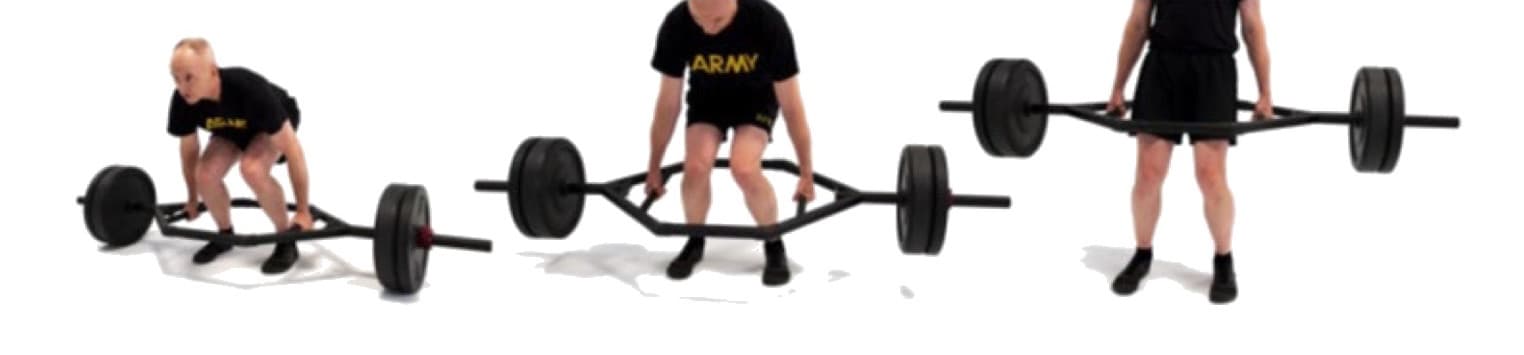
Inside the hex bar with feet shoulder-width apart, gripping the center of the handles with a closed grip. Arms fully extended, back flat, head in line with the spine or slightly extended, and both heels on the ground. Every repetition starts from this position.
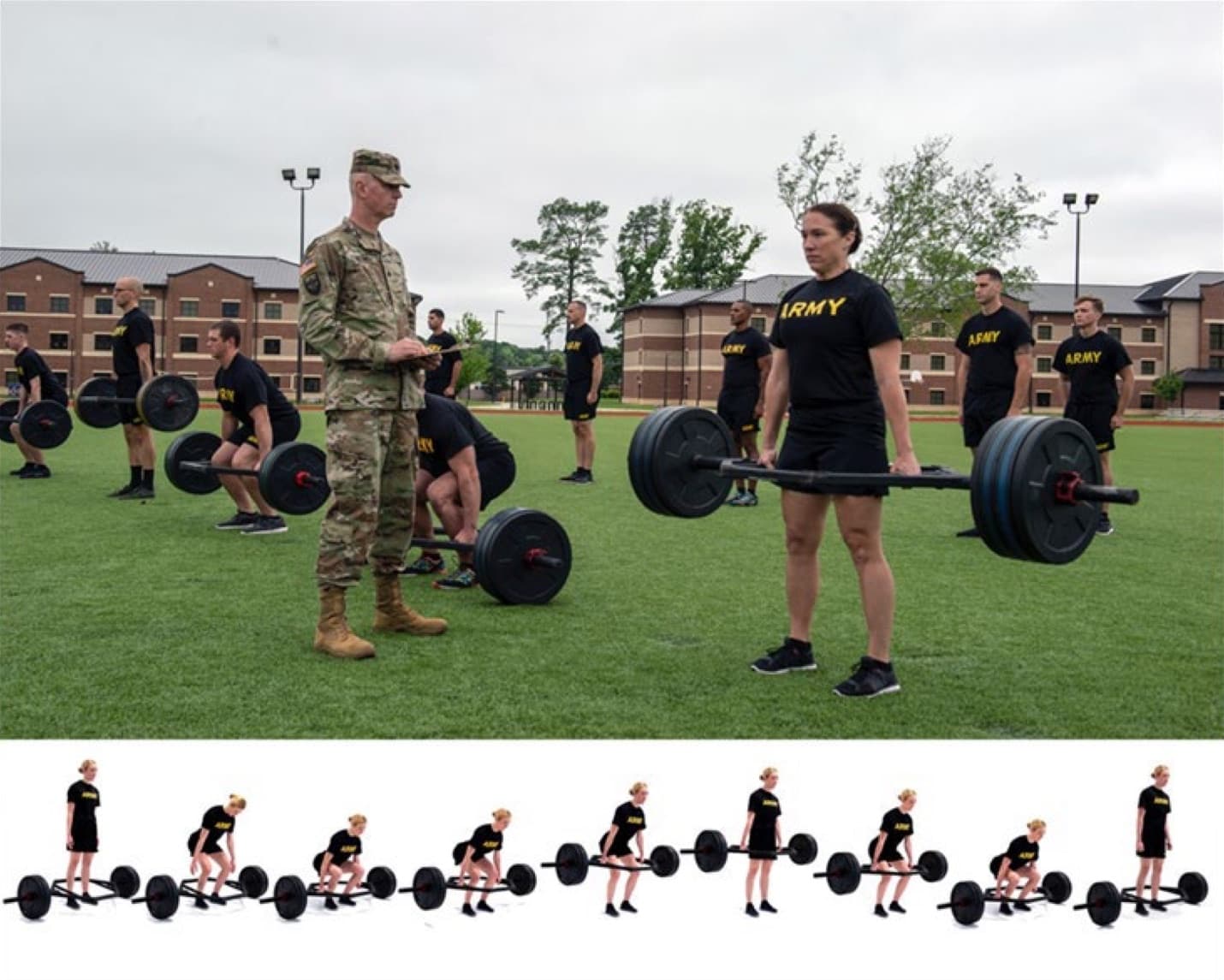
Steps
Step 1: Prepare“GET SET”
- Step inside the hex bar, feet shoulder-width apart, and find the mid-point of the handles.
- Bend at the knees and hips, reach down, and grasp the center of the handles with a closed grip (thumb wrapped around the handle opposite the fingers).
Step 2: Lift“GO”
- Straighten the hips and knees to stand up into the Straddle Stance.
- Do not let the hips rise before or above the shoulders. Keep the back straight and the feet in place, staying balanced and in control.
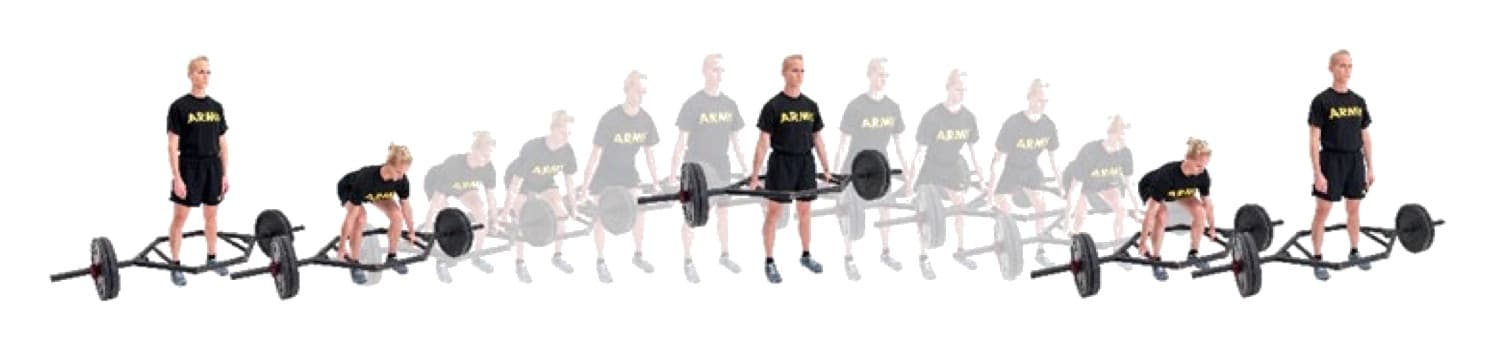
Figure 2-4. Proper technique to execute the Maximum Deadlift · ATP 7-22.01, p. 27 (PDF) opens the official publication in a new tab Step 3: Lower
- Lower the bar to the ground under control with a straight back.
- Place the bar down; do not drop it. The plates must touch the ground to finish the repetition.
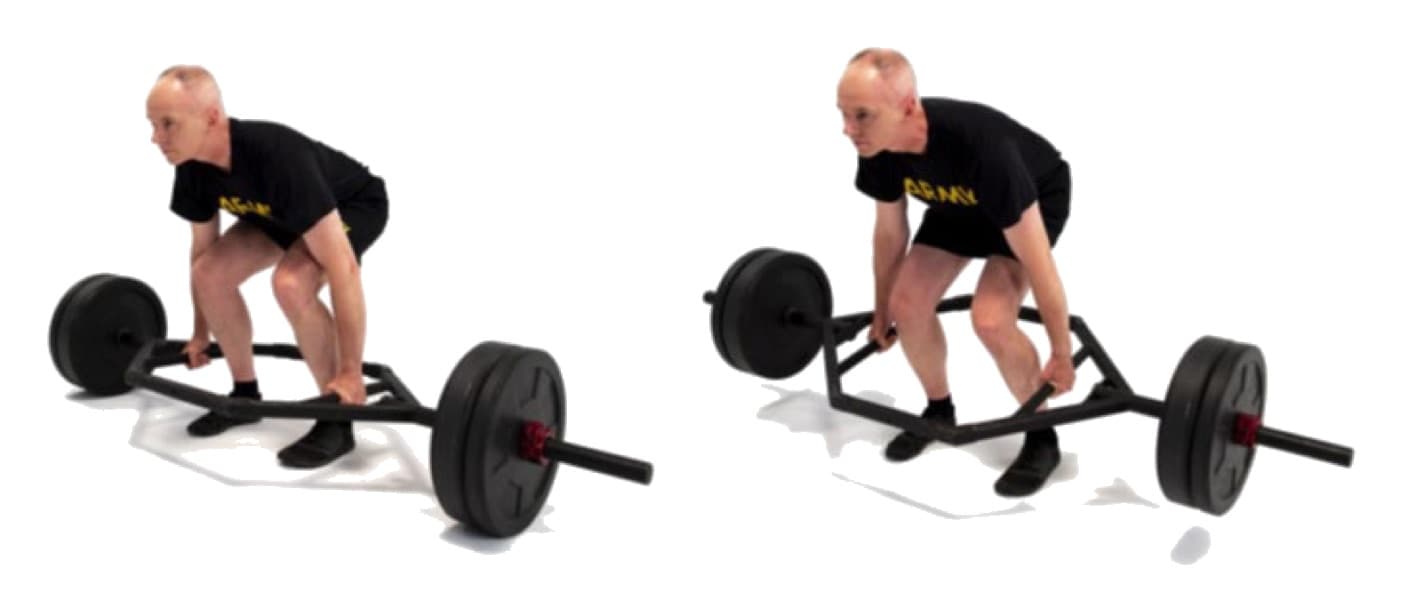
Figure 2-7. Touching the plates to the ground versus not touching the ground · ATP 7-22.01, p. 29 (PDF) opens the official publication in a new tab Step 4: Repeat
- Complete three continuous repetitions without resting on the ground.
Proper form and what's allowed
- Recommended 10-minute MDL warm-up: 8–10 reps at 25% of goal weight or the empty bar (rest 2 min), 6 reps at 40% (rest 3 min), 4 reps at 50% (rest 4 min or until the event starts), and an optional 1 rep at 80%.
- Adjusting the grip while keeping contact with the bar.
- Moving to another lane that already has the next target weight.
- Hex bars with adjustable handle width and walk-in hex bars.
- Gloves that conform to AR 670-1 may be worn for any event.
Breathing: ATP 7-22.01 gives no breathing guidance for this event, so none is given here.
ATP 7-22.01 (12 Mar 2026), para. 2-45 – 2-46, p. 27; ATP 7-22.01 (12 Mar 2026), para. 2-46, p. 27
Common mistakes and invalid repetitions
Safety stops
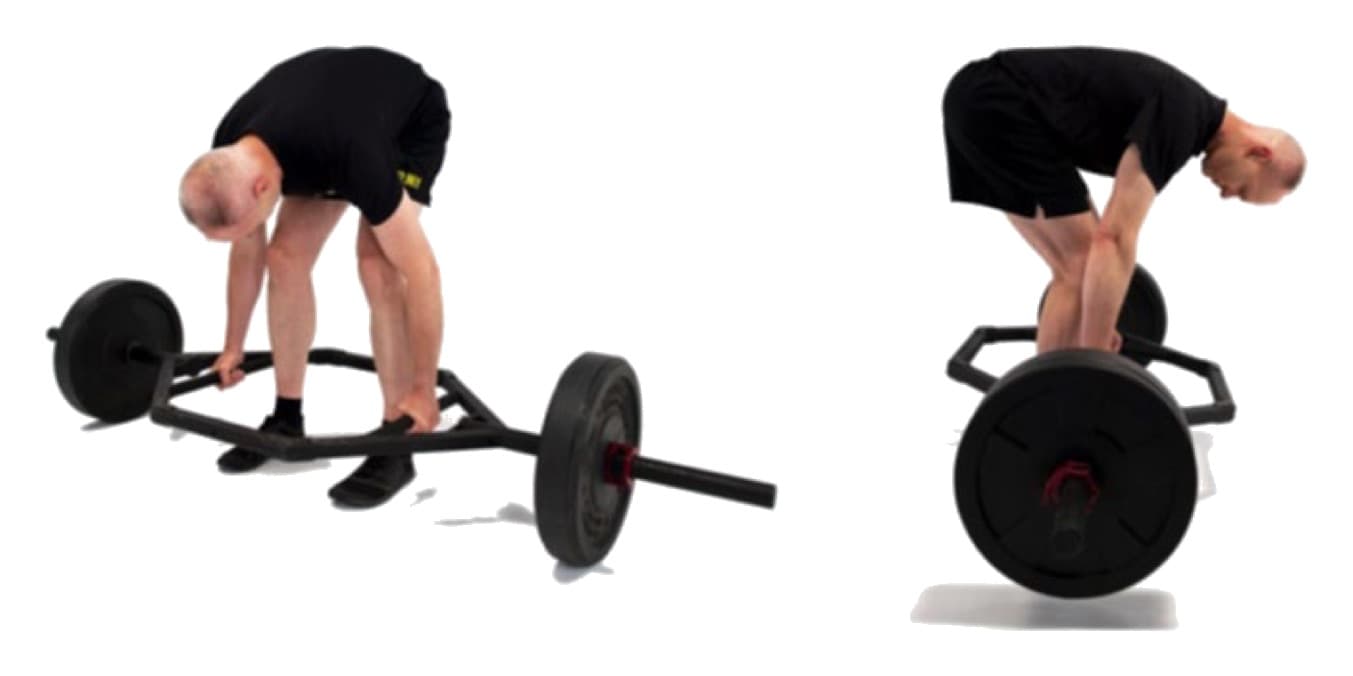
- Knees moving closer together during any part of the lift (safety stop).
- Hips rising above the shoulders to start the lift (safety stop).
- Back or shoulders rounding during any part of the lift (safety stop).
- Losing balance, including stepping forward or backward (safety stop).
Termination
- Not fully extending the legs to reach the Straddle Stance.
- Dropping the bar.
- Taking the hands off the bar between repetitions while it is on the ground.
- Not touching the bar to the ground between repetitions.
- Resting on the ground (an obvious lack of effort to lift).
- A safety stop on the second or third repetition.
ATP 7-22.01 (12 Mar 2026), para. 2-47 – 2-48, p. 28; ATP 7-22.01 (12 Mar 2026), para. 2-50, p. 28–29
Completion, attempts, timing, and rest
- A successful attempt is 3 continuous repetitions to standard.
- Each Soldier has two attempts. After a successful first attempt, the Soldier may make one attempt at a heavier weight. After a failed first attempt, the Soldier may make one more attempt at the same or a lower weight.
- The raw score is the heaviest weight successfully lifted.
- There is no programmed rest before the next event unless only one or two Soldiers are testing (then 5 minutes).
ATP 7-22.01 (12 Mar 2026), para. 2-37, 2-43, 2-46, 2-48 – 2-52, p. 25–29
Grader instructions
- The grader gives "GET SET" and "GO" for each attempt.
- The grader records each attempt, checks the maximum weight successfully lifted, and initials the MDL box on DA Form 705-TEST.
- The grader returns the scorecard to the Soldier and reports to the OIC or NCOIC for HRP lane assignment.
Commands and grader responsibilities
| Command | Who and what happens |
|---|---|
| GET READY | NCOIC: the first Soldier in each stack stands in front of the hex bar. |
| GRADERS READY | NCOIC, once all Soldiers are ready; graders signal visually. |
| THE MAXIMUM DEADLIFT STARTS NOW | NCOIC. |
| GET SET | Grader: the Soldier steps inside the hex bar into the start position. |
| GO | Grader: starts the attempt. |
| NEXT SOLDIER MOVE FORWARD | Grader, after each Soldier finishes. |
Grader responsibilities
- Call a safety stop on an unsafe first repetition, explain the error, and let the Soldier restart.
- Terminate the attempt and record a failed attempt for a safety stop on the second or third repetition.
- After a successful attempt, record the weight and ask whether the Soldier wants to try a heavier weight.
ATP 7-22.01 (12 Mar 2026), para. 2-12, 2-43, 2-47 – 2-51, p. 18–19, 26–29; ATP 7-22.01 (12 Mar 2026), para. 2-43, p. 26
Safety
- A safety stop on the first repetition is not a record attempt: the grader explains the error and the Soldier restarts the attempt. It exists to prevent repeated movements that could cause injury.
- Collars keep plates from moving during the lift.
- Soldiers should know their goal weight and have lifted it in training before the test.
- Chalk, powder, weightlifting belts, and wrist straps are not authorized.
ATP 7-22.01 (12 Mar 2026), para. 2-21 note, 2-42, 2-47; E-7, p. 21, 26, 28, 88
Scoring and training
Raw score: Heaviest weight lifted for 3 correct repetitions (pounds). Higher is better. Points run from 0 to 100 using the June 2025 score tables, by age group and, for the general standard, sex.
Both the general and combat standards require at least 60 points on this event; the combat standard also requires a total of at least 350.
Prepare with the exercise library
The ATP starts every AFT with the Preparation Drill and ends with the Recovery Drill.
Exercises RuckOn maps to this event (an app mapping, not an Army designation):
- Squat Bender
- Back Bridge
- Sumo Squat
- Straight-Leg Deadlift
- Deadlift
- Single-Leg Deadlift
- Bent-Over Row
- Front Squat
- Back Squat
- Single-Arm Bent-Over Row
Muscles and movement (RuckOn explanation)
RuckOn anatomical explanation for training purposes. The Army's own description is in “What it measures and why.”
- Primary
- Gluteus maximus, Quadriceps, Hamstrings, Spinal erectors
- Secondary
- Forearm and grip muscles, Trapezius, Abdominal and trunk muscles
- Movement patterns
- Hip hinge with knee bend (hex-bar lift), Two-leg lift from the ground, Grip and trunk bracing
ATP 7-22.01 (12 Mar 2026), para. 2-30, p. 23; AFT Scoring Scales effective 1 June 2025
Demonstration and sources
U.S. Army Holistic Health and Fitness (YouTube)
Official U.S. Army Holistic Health and Fitness video linked from army.mil/aft. It was titled for the ACFT and may predate the June 2025 AFT and the March 2026 ATP; where anything differs, follow ATP 7-22.01 (March 2026). RuckOn has not reviewed the video frame by frame.
Photos and illustrations: ATP 7-22.01, Holistic Health and Fitness Testing (U.S. Army, 12 March 2026). Approved for public release; distribution is unlimited.
Source notes
Where the official text is inconsistent, it is reported here rather than resolved:
- The ATP's plate arrangement table goes up to 340 pounds, while the June 2025 score tables award points up to 350 pounds in some age groups. The ATP does not show a 350-pound arrangement.
- ATP 7-22.01, Holistic Health and Fitness Testing(opens in a new tab)
12 March 2026. Current. Supersedes ATP 7-22.01, 1 October 2020.
- AFT Scoring Scales, Army Fitness Test Score Tables(opens in a new tab)
Approved 15 May 2025, effective 1 June 2025. Listed as the current AFT scoring tables on army.mil/aft when checked.
- army.mil/aft, Army Fitness Test website(opens in a new tab)
Checked 2 October 2026. The ATP names this site for event descriptions and instructional videos.
- Army Directive 2026-07, Army Physical Fitness Standards(opens in a new tab)
17 April 2026 (armypubs record date). Active. Supersedes Army Directive 2025-06 in part and controls where it conflicts with other Army regulations or directives.
Content checked against the publications on 2026-10-02.
RuckOn Fitness is not affiliated with or endorsed by the U.S. Army, and this guide is not a grader certification. Test administration follows ATP 7-22.01 and your unit's OIC or NCOIC.
Event 2 of 5
Hand-Release Push-Up
A two-minute timed event that measures upper-body muscular endurance.
What it measures and why
A two-minute timed event that measures upper-body muscular endurance.
The Army links the HRP to repetitive and sustained pushing in combat tasks: pushing an opponent away, pushing a stuck vehicle, and pushing up from the ground during evade and maneuver. It also works upper-back muscles used when reaching out from the prone position, taking cover, or low crawling.
Army-named fitness components: Upper-body muscular endurance.
ATP 7-22.01 (12 Mar 2026), para. 2-56, p. 30
Equipment and station setup
Equipment per lane
- 2 × Stopwatches — Used by the OIC or NCOIC and a back-up timer; one common clock times every lane.
- Foam or rubber mats — Optional. Sleeping mats are not authorized.
Station setup
- Test one Soldier per lane with one grader per lane.
- The OIC or NCOIC (or timer) runs a common 2:00 clock for all lanes; individual graders do not time the HRP.
- Graders kneel or sit where they can check the Soldier's hands, chest, body, and feet.
ATP 7-22.01 (12 Mar 2026), para. 2-22, p. 21; ATP 7-22.01 (12 Mar 2026), para. 2-53 – 2-54, 2-62, p. 29–31
How to perform it
Starting position
Prone, with hands flat on the ground beneath the shoulders and index fingers inside the outer edge of the shoulders. Chest and the front of the hips and thighs on the ground, toes on the ground, feet together or up to a boot's width apart (measured by the grader), ankles flexed. The head does not have to touch the ground.

Steps
Step 1: Movement 1: push up“GO”
- Push the whole body up as a single unit until the elbows are fully extended in the front leaning rest.
Step 2: Movement 2: lower
- Bend the elbows to lower the body. Chest, hips, and thighs touch the ground together; the head or face does not have to.
Step 3: Movement 3: hand release
- Without moving the head, body, or legs, extend both arms straight out to the sides into a T. The arms and hands may touch or slide along the ground.
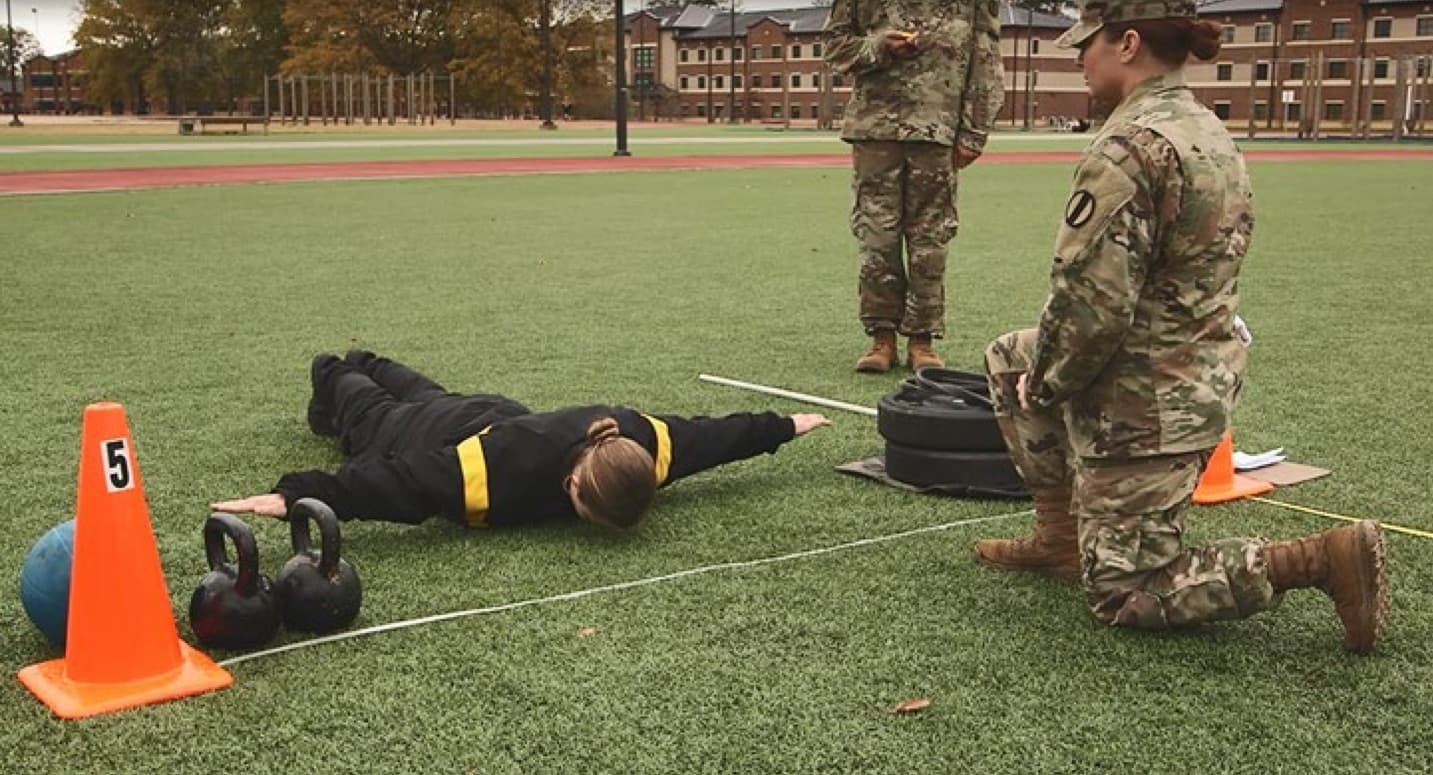
Figure 2-8. Hand-Release Push-Up · ATP 7-22.01, p. 30 (PDF) opens the official publication in a new tab Step 4: Movement 4: return
- Immediately bring the hands back to the starting position to complete the repetition.
Proper form and what's allowed
- Soldiers should not wear glasses during the HRP.
- Keep the head in line with the body and the eyes on the ground.
- Do not "snake" off the ground; the body moves as one unit.
- Correct a movement error immediately.
- Performing the exercise on the knuckles (hands in fists) and switching between fists and flat hands; a fist must be inside the outer edge of the shoulder.
- Resting only in the front leaning rest.
- Using an optional mat, as long as the whole body is on it except the arms during the hand release.
- Gloves that conform to AR 670-1 may be worn for any event.
Breathing: ATP 7-22.01 gives no breathing guidance for this event, so none is given here.
ATP 7-22.01 (12 Mar 2026), para. 2-57 – 2-58, p. 30–31; ATP 7-22.01 (12 Mar 2026), para. 2-58, p. 31
Common mistakes and invalid repetitions
Repetitions or positions that don't count
- Not keeping a straight body line from head to ankles, including extending the neck or arching the back to keep the chest off the ground.
- Not extending both arms into a generally straight T.
- Not fully extending the elbows in the up position.
- Not returning the hands to the starting position.
- Feet more than a boot's width apart.
Termination
- Bending at the shoulders, hips, or knees while in the front leaning rest.
- Lifting a foot at any time, or lifting a hand while in the front leaning rest.
- Placing a knee on the ground from the front leaning rest.
- Not making a continuous effort to rise from the ground (resting on the ground).
- Repeating the hand release before rising from the ground.
ATP 7-22.01 (12 Mar 2026), para. 2-59, p. 31; ATP 7-22.01 (12 Mar 2026), para. 2-60, 2-62, p. 31
Completion, attempts, timing, and rest
- The raw score is the number of correct repetitions completed in two minutes.
- If the event is terminated for resting on the ground, the score earned before resting is recorded.
ATP 7-22.01 (12 Mar 2026), para. 2-62 – 2-64, p. 31–32
Grader instructions
- Graders kneel or sit to check the Soldier's hands, chest, body, and feet.
- Graders count correct repetitions aloud and record them on DA Form 705-TEST.
- The NCOIC starts each group; the timer runs the 2:00 clock for all lanes.
Commands and grader responsibilities
| Command | Who and what happens |
|---|---|
| GET READY | NCOIC: the first Soldier in each lane moves to the start line. |
| GRADERS READY | NCOIC; graders signal visually. |
| GET SET | NCOIC: Soldiers take the HRP start position. |
| GO | NCOIC: Soldiers begin and the common 2:00 clock starts. |
| ONE MINUTE REMAINING / 30 SECONDS REMAINING | Timer. |
| 10 SECONDS, 9, 8, 7, 6, 5, 4, 3, 2, 1, STOP | Timer ends the event. |
| NEXT SOLDIER MOVE FORWARD | NCOIC. |
Grader responsibilities
- Measure foot width with the grader's boot.
- Give the Soldier the standard instructions before the event (glasses, head position, continuous effort, feet, elbow extension, immediate correction, knuckle option).
ATP 7-22.01 (12 Mar 2026), para. 2-12, 2-54, 2-62 – 2-63, p. 18–19, 30–31; ATP 7-22.01 (12 Mar 2026), para. 2-53 – 2-54, p. 29–30
Safety
- Sleeping mats are not authorized; if a mat is used, the whole body must be on it except the arms during the hand release.
ATP 7-22.01 (12 Mar 2026), para. 2-61, p. 31
Scoring and training
Raw score: Correct repetitions in 2 minutes. Higher is better. Points run from 0 to 100 using the June 2025 score tables, by age group and, for the general standard, sex.
Both the general and combat standards require at least 60 points on this event; the combat standard also requires a total of at least 350.
Prepare with the exercise library
The ATP starts every AFT with the Preparation Drill and ends with the Recovery Drill.
Exercises RuckOn maps to this event (an app mapping, not an Army designation):
- Push-Up
- Single-Leg Push-Up
- 8-Count T Push-Up
- Supine Chest Press
- Bent-Over Row
- Bench Press
- Single-Arm Bent-Over Row
Muscles and movement (RuckOn explanation)
RuckOn anatomical explanation for training purposes. The Army's own description is in “What it measures and why.”
- Primary
- Pectoralis major, Triceps brachii, Anterior deltoids
- Secondary
- Serratus anterior, Upper-back muscles (rhomboids, middle trapezius, rear deltoids) during the hand release, Abdominal and hip muscles holding the straight body line
- Movement patterns
- Horizontal push, Shoulder-blade retraction (T position), Trunk stability in a straight-body position
ATP 7-22.01 (12 Mar 2026), para. 2-30, p. 23; AFT Scoring Scales effective 1 June 2025
Demonstration and sources
U.S. Army Holistic Health and Fitness (YouTube)
Official U.S. Army Holistic Health and Fitness video linked from army.mil/aft. It was titled for the ACFT and may predate the June 2025 AFT and the March 2026 ATP; where anything differs, follow ATP 7-22.01 (March 2026). RuckOn has not reviewed the video frame by frame.
Photos and illustrations: ATP 7-22.01, Holistic Health and Fitness Testing (U.S. Army, 12 March 2026). Approved for public release; distribution is unlimited.
- ATP 7-22.01, Holistic Health and Fitness Testing(opens in a new tab)
12 March 2026. Current. Supersedes ATP 7-22.01, 1 October 2020.
- AFT Scoring Scales, Army Fitness Test Score Tables(opens in a new tab)
Approved 15 May 2025, effective 1 June 2025. Listed as the current AFT scoring tables on army.mil/aft when checked.
- army.mil/aft, Army Fitness Test website(opens in a new tab)
Checked 2 October 2026. The ATP names this site for event descriptions and instructional videos.
- Army Directive 2026-07, Army Physical Fitness Standards(opens in a new tab)
17 April 2026 (armypubs record date). Active. Supersedes Army Directive 2025-06 in part and controls where it conflicts with other Army regulations or directives.
Content checked against the publications on 2026-10-02.
RuckOn Fitness is not affiliated with or endorsed by the U.S. Army, and this guide is not a grader certification. Test administration follows ATP 7-22.01 and your unit's OIC or NCOIC.
Event 3 of 5
Sprint-Drag-Carry
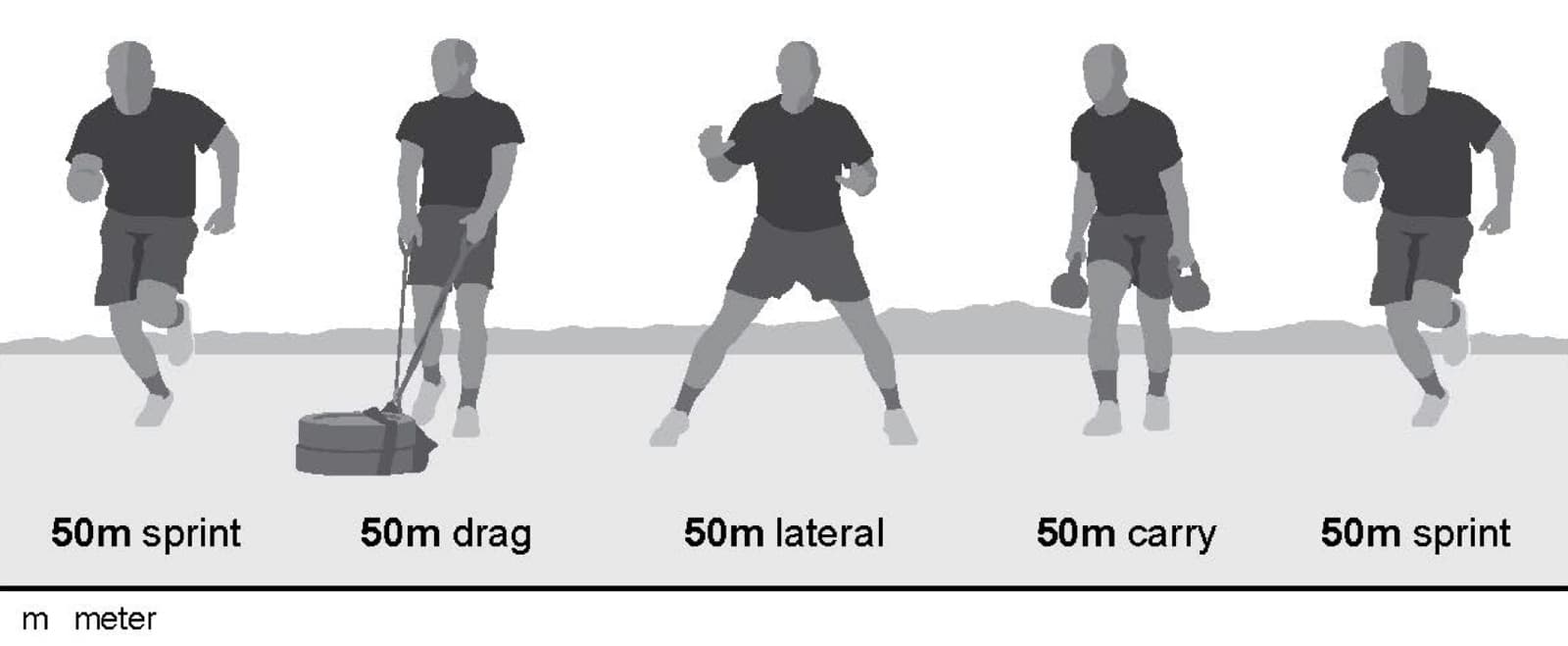
A timed 250-meter shuttle event (5 × 50 meters) that measures anaerobic capacity, muscular endurance, and muscular strength.
What it measures and why
A timed 250-meter shuttle event (5 × 50 meters) that measures anaerobic capacity, muscular endurance, and muscular strength.
The Army describes these as the capacities needed for high-intensity tasks lasting a few seconds to a few minutes, such as reacting to direct and indirect fire, building a hasty fighting position, and extracting a casualty and carrying them to safety.
Army-named fitness components: Anaerobic capacity, Muscular endurance, Muscular strength.
ATP 7-22.01 (12 Mar 2026), para. 2-67, p. 33
Equipment and station setup
Equipment per lane
- 1 × Nylon sled with pull strap — Sled 22 × 19.5 inches, holds up to four 45-pound plates; one-piece strap 92 inches (±2) with a loop handle at each end.
- 2 × 45-pound bumper plates on the sled — Four plates (180 pounds) on a modified surface.
- 2 × 40-pound kettlebells — Within 2 pounds of 40 pounds, about 11 inches (±1) tall, flat base so the handle stands vertical.
- 2 × Stopwatches — OIC or NCOIC and the lane grader; the start-line grader may use one or two to time both Soldiers in adjacent lanes.
Station setup
- Lanes are 25 meters long and 2.5–3.0 meters wide, marked every 5 meters, with about 4 meters past the 25-meter line for the sled turn-around and about 8 meters behind the start line for staging and the finish.
- Use a standard surface (maintained grass or artificial turf, two 45-pound plates on the sled) when possible. On a modified surface (wood, packed dirt, vinyl, or smooth concrete) the OIC or NCOIC puts four 45-pound plates on the sled.
- Do not use restricted surfaces: unimproved dirt or gravel, rubberized track or gym floors, ice, or snow.
- Indoor lanes need enough space at both ends to turn and to sprint through the finish.
- Inspect the sled and pull strap for torn fabric or stitching.
- On "GET READY," each Soldier arranges the SDC equipment at the start line.
ATP 7-22.01 (12 Mar 2026), para. 2-23; E-9 – E-14, p. 21–22, 89–90; ATP 7-22.01 (12 Mar 2026), para. 2-16 – 2-18, 2-66; E-10 – E-11, E-29; equipment safety note, p. 19–20, 32, 89, 93
How to perform it
Starting position
Prone with the hands on the ground beneath the shoulders and the top of the head behind the start line.
Steps
Step 1: Shuttle 1: sprint“GO”
- Get up from the prone position and sprint 25 meters. Touch the 25-meter line with a foot and a hand, turn, and sprint back to the start.
Step 2: Shuttle 2: drag
- Grasp each strap handle and pull the sled backward until the whole sled crosses the 25-meter line, then turn and drag it back to the start line.
- The strap must pass freely through the sled's D-ring and may not be twisted, wrapped, or knotted.
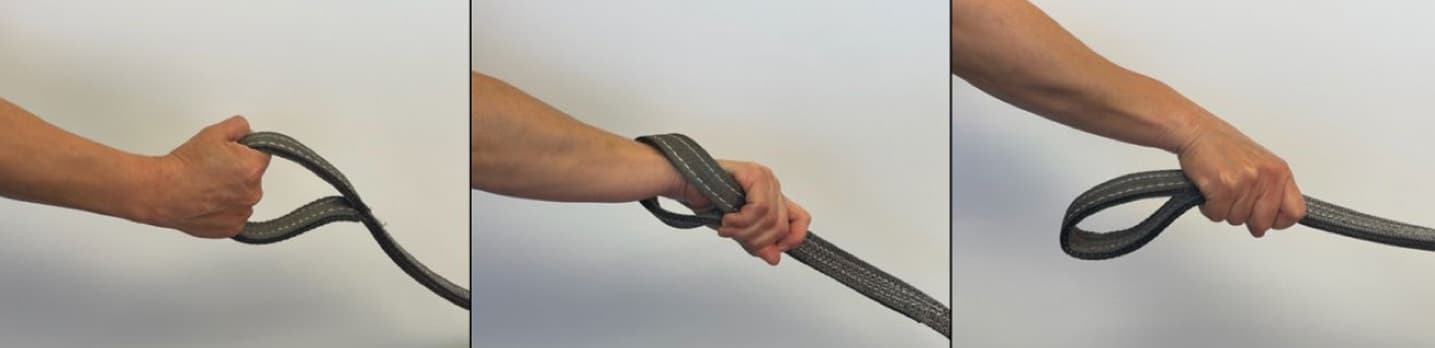
Figure 2-11. Authorized strap handle grips · ATP 7-22.01, p. 33 (PDF) opens the official publication in a new tab Step 3: Shuttle 3: lateral
- Move laterally 25 meters leading with one foot, touch the 25-meter line with a foot and a hand, and return leading with the other foot.
- Face the same direction out and back. The feet do not cross and stay parallel to each other and perpendicular to the direction of travel.
Step 4: Shuttle 4: carry
- Pick up both 40-pound kettlebells with a closed grip and carry them at your sides (farmer's carry only). Run 25 meters, touch the 25-meter line with a foot, and return.
- Keep the kettlebells upright with the handles up. After crossing the start line, set them down without dropping them.
Step 5: Shuttle 5: sprint
- Sprint 25 meters, touch the 25-meter line with a foot and a hand, then sprint back across the start line to finish.
Proper form and what's allowed
- Three sled-strap grips only: fingers through the loops; hands completely through the loops gripping just below the sewn portion; or gripping below the loops at the sewn portion.
- Leading with either foot on the first lateral leg (then the other foot on the way back).
- Gloves that conform to AR 670-1 may be worn for any event.
Breathing: ATP 7-22.01 gives no breathing guidance for this event, so none is given here.
ATP 7-22.01 (12 Mar 2026), para. 2-68, 2-70, p. 33–34
Common mistakes and invalid repetitions
Call-backs
- Not touching the 25-meter line with a foot and a hand on the sprints and lateral: the grader calls the Soldier back to do so.
- Not getting the whole sled across the 25-meter line: the grader calls the Soldier back.
- Not touching the 25-meter line with a foot on the carry: the grader calls the Soldier back.
- Dropping the kettlebells at the start line: the grader calls the Soldier back to set them down under control.
Termination
The ATP lists no termination criteria for this event.
ATP 7-22.01 (12 Mar 2026), para. 2-68, p. 33–34
Completion, attempts, timing, and rest
- The event is five continuous 50-meter shuttles in order: sprint, drag, lateral, carry, sprint.
- The start-line grader records the time after both Soldiers in the adjacent lanes cross the finish line.
ATP 7-22.01 (12 Mar 2026), para. 2-68 – 2-70, p. 33–34
Grader instructions
- Two graders work together across two adjacent lanes and stay at the ends of the lanes; they do not run with the Soldiers.
- The start-line grader starts and records the time for both Soldiers and enforces standards at the start line.
- The 25-meter grader confirms correct foot and hand touches and that the sled crosses the line.
Commands and grader responsibilities
| Command | Who and what happens |
|---|---|
| GET READY | NCOIC: the first Soldier in each lane arranges the equipment and takes the ready position. |
| GRADERS READY | NCOIC; graders signal visually. |
| GET SET | NCOIC: Soldiers take the prone start position. |
| GO | NCOIC: the start-line grader starts the stopwatch. |
| NEXT SOLDIER, MOVE FORWARD | NCOIC, once all lanes finish. |
Grader responsibilities
- Call Soldiers back to fix a missed touch or a sled that did not cross the line.
- Record the SDC time on DA Form 705-TEST.
ATP 7-22.01 (12 Mar 2026), para. 2-12 – 2-13, 2-65 – 2-66, 2-69, p. 18–19, 32, 34; ATP 7-22.01 (12 Mar 2026), para. 2-66, p. 32
Safety
- Each grader controls two adjacent lanes to keep Soldiers and graders safe and to prevent interference between lanes.
- Choose the safest surface; standard surfaces should be the primary choice. No adjustments to SDC standards or scoring are authorized other than the sled weight for a modified surface.
- Check the sled and strap for torn fabric or stitching before the test.
ATP 7-22.01 (12 Mar 2026), para. 2-12, 2-18; E-11; equipment safety note, p. 19–20, 89
Scoring and training
Raw score: Total time (mm:ss). Lower (faster) is better. Points run from 0 to 100 using the June 2025 score tables, by age group and, for the general standard, sex.
Both the general and combat standards require at least 60 points on this event; the combat standard also requires a total of at least 350.
Prepare with the exercise library
The ATP starts every AFT with the Preparation Drill and ends with the Recovery Drill.
Exercises RuckOn maps to this event (an app mapping, not an Army designation):
- Forward Lunge
- Lateral
- Shuttle Sprint
- Mountain Climber
- Turn and Lunge
- Half Jack
- Half-Squat Laterals
- 8-Count Step-Up
- Heel Raise
Muscles and movement (RuckOn explanation)
RuckOn anatomical explanation for training purposes. The Army's own description is in “What it measures and why.”
- Primary
- Quadriceps, Gluteal muscles, Hamstrings, Calves
- Secondary
- Hip abductors and adductors (lateral), Grip, forearm, and trapezius muscles (drag and carry), Trunk muscles
- Movement patterns
- Sprinting and turning, Backward sled drag, Lateral movement, Loaded carry, Getting up from the ground quickly
ATP 7-22.01 (12 Mar 2026), para. 2-30, p. 23; AFT Scoring Scales effective 1 June 2025
Demonstration and sources
U.S. Army Holistic Health and Fitness (YouTube)
Official U.S. Army Holistic Health and Fitness video linked from army.mil/aft. It was titled for the ACFT and may predate the June 2025 AFT and the March 2026 ATP; where anything differs, follow ATP 7-22.01 (March 2026). RuckOn has not reviewed the video frame by frame.
Photos and illustrations: ATP 7-22.01, Holistic Health and Fitness Testing (U.S. Army, 12 March 2026). Approved for public release; distribution is unlimited.
Source notes
Where the official text is inconsistent, it is reported here rather than resolved:
- The ATP lists call-backs for missed touches but does not list termination criteria for the SDC.
- The restricted-surface list in para. 2-17 includes "rubberized track or gym floors"; the list in para. E-10 names only rubberized track.
- ATP 7-22.01, Holistic Health and Fitness Testing(opens in a new tab)
12 March 2026. Current. Supersedes ATP 7-22.01, 1 October 2020.
- AFT Scoring Scales, Army Fitness Test Score Tables(opens in a new tab)
Approved 15 May 2025, effective 1 June 2025. Listed as the current AFT scoring tables on army.mil/aft when checked.
- army.mil/aft, Army Fitness Test website(opens in a new tab)
Checked 2 October 2026. The ATP names this site for event descriptions and instructional videos.
- Army Directive 2026-07, Army Physical Fitness Standards(opens in a new tab)
17 April 2026 (armypubs record date). Active. Supersedes Army Directive 2025-06 in part and controls where it conflicts with other Army regulations or directives.
Content checked against the publications on 2026-10-02.
RuckOn Fitness is not affiliated with or endorsed by the U.S. Army, and this guide is not a grader certification. Test administration follows ATP 7-22.01 and your unit's OIC or NCOIC.
Event 4 of 5
Plank
A test of core-static strength and endurance.
What it measures and why
A test of core-static strength and endurance.
The ATP describes the plank as a test of core-static strength and endurance and does not state a further purpose.
Army-named fitness components: Core-static strength, Core endurance.
ATP 7-22.01 (12 Mar 2026), para. 2-72, p. 35
Equipment and station setup
Equipment per lane
- 1 × Stopwatch — One per lane, used by the grader.
- Foam or rubber mats — Optional. Sleeping mats are not authorized.
Station setup
- Graders test each Soldier in their lane individually, positioned to observe the plank position.
- If a mat is used, the Soldier's entire body must be on it.
ATP 7-22.01 (12 Mar 2026), para. 2-24, p. 22; ATP 7-22.01 (12 Mar 2026), para. 2-71, 2-73, p. 34–36
How to perform it
Starting position
On "GET READY": hands on the ground as fists (pinky side down) or flat with palms down, elbows bent under the shoulders, forearms flat forming a triangle, fingers not interlocked or interlaced, hips bent with one or both knees on the ground. On "GET SET": lift both knees and bring the hips into a straight line with the legs, shoulders, and head, eyes on the ground, feet up to the grader's boot width apart, ankles flexed with the bottom of the toes on the ground.
Steps
Step 1: Ready position“GET READY”
- Take the forearm ready position with one or both knees on the ground.
Step 2: Set“GET SET”
- Lift both knees and bring the body into a straight line from head to ankles, similar to the front leaning rest.
Step 3: Hold“GO”
- Hold a straight line through the head, shoulders, back, hips, and legs.
- Keep the feet, forearms, and fists or palms in contact with the ground for the whole event.
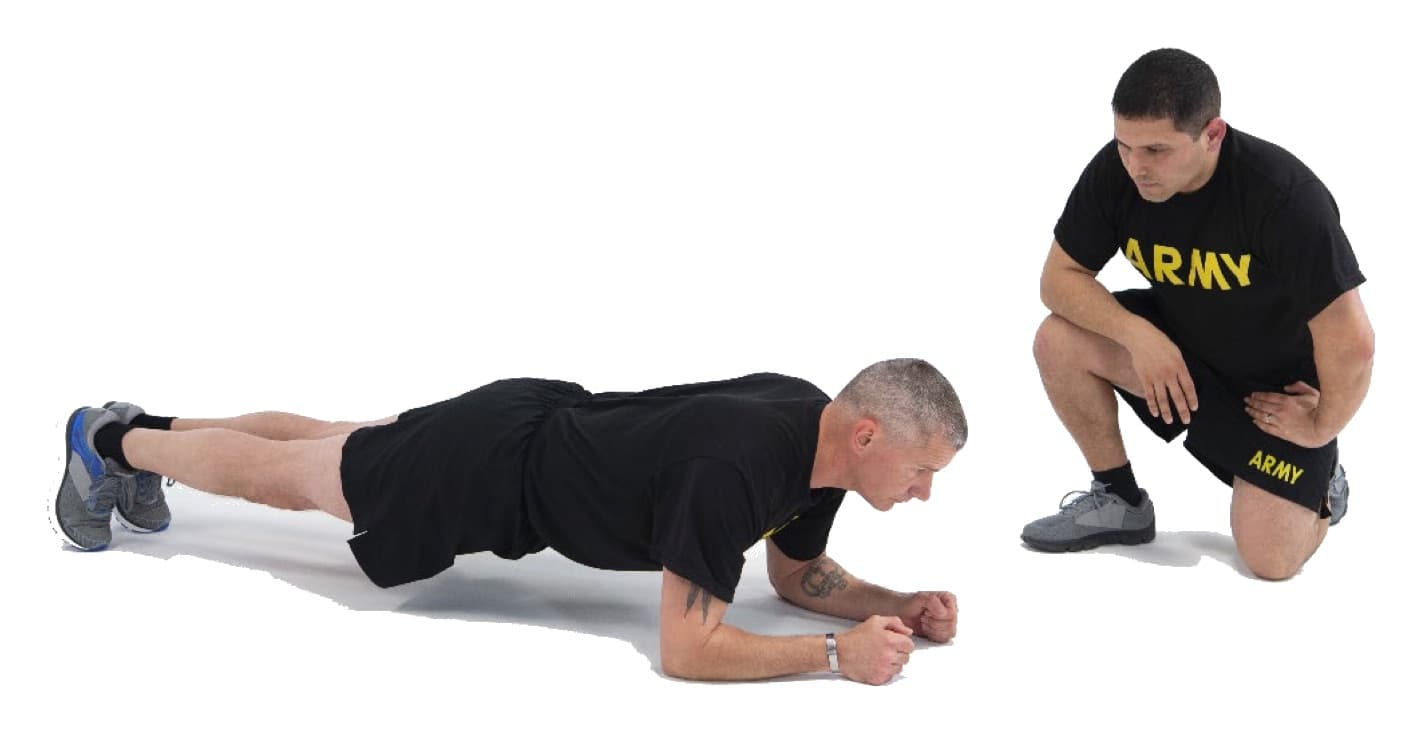
Figure 2-12. Plank · ATP 7-22.01, p. 35 (PDF) opens the official publication in a new tab
Proper form and what's allowed
- Fingers of the two hands may not be interlocked, interlaced, or touching.
- Switching between fists (pinky side down) and palms down, as long as the hands stay in contact with the ground.
- Shaking or trembling from maximum effort, as long as the proper position is held.
- Gloves that conform to AR 670-1 may be worn for any event.
Breathing: ATP 7-22.01 gives no breathing guidance for this event, so none is given here.
ATP 7-22.01 (12 Mar 2026), para. 2-73, p. 35
Common mistakes and invalid repetitions
Repetitions or positions that don't count
- Losing the straight-line position, or the hands or feet sliding out of position: the grader gives one verbal warning to correct it.
Termination
- Touching the ground with any part of the body other than the feet, forearms, and fists or palms.
- Raising a foot or hand off the ground.
- Failing to hold the straight-line position from head to heels.
- Not correcting a deficiency after the one verbal warning.
ATP 7-22.01 (12 Mar 2026), para. 2-73, p. 35
Completion, attempts, timing, and rest
- The raw score is the time the Soldier holds the proper plank position.
- When the last Soldier finishes the plank, the OIC or NCOIC starts a 10-minute rest before the 2-mile run.
ATP 7-22.01 (12 Mar 2026), para. 2-71, 2-75, p. 34–36
Grader instructions
- The grader starts the stopwatch on "GO" and calls the elapsed time every 15 seconds.
- The grader records the plank time on DA Form 705-TEST.
- Soldiers rotate through the lane; from the second Soldier on, the grader gives "GET SET" and "GO."
Commands and grader responsibilities
| Command | Who and what happens |
|---|---|
| GET READY | NCOIC: Soldiers take the ready position on the ground. |
| GRADERS READY | NCOIC; graders signal visually. |
| GET SET | Soldiers lift into the plank start position. |
| GO | Soldiers hold the plank and the grader starts the stopwatch. From the second Soldier on, the lane grader gives GET SET and GO. |
| 15-second time calls | The grader announces elapsed time every 15 seconds. |
Grader responsibilities
- Measure hand and foot spacing against the grader's fist or boot.
- Give one verbal warning for a position error, then terminate the event if the Soldier cannot correct it.
ATP 7-22.01 (12 Mar 2026), para. 2-71, 2-73 – 2-74, p. 34–36; ATP 7-22.01 (12 Mar 2026), para. 2-71, 2-73, p. 34–35
Safety
- Sleeping mats are not authorized; if a mat is used, the Soldier's entire body must be on it.
ATP 7-22.01 (12 Mar 2026), para. 2-73, p. 36
Scoring and training
Raw score: Time held in the proper plank position (mm:ss). Higher is better. Points run from 0 to 100 using the June 2025 score tables, by age group and, for the general standard, sex.
Both the general and combat standards require at least 60 points on this event; the combat standard also requires a total of at least 350.
Prepare with the exercise library
The ATP starts every AFT with the Preparation Drill and ends with the Recovery Drill.
Exercises RuckOn maps to this event (an app mapping, not an Army designation):
Muscles and movement (RuckOn explanation)
RuckOn anatomical explanation for training purposes. The Army's own description is in “What it measures and why.”
- Primary
- Rectus abdominis, Transversus abdominis, Obliques
- Secondary
- Spinal erectors, Gluteal muscles, Shoulder muscles (deltoids, serratus anterior), Quadriceps
- Movement patterns
- Holding the trunk still against gravity (anti-extension), Shoulder stability on the forearms
ATP 7-22.01 (12 Mar 2026), para. 2-30, p. 23; AFT Scoring Scales effective 1 June 2025
Demonstration and sources
U.S. Army Holistic Health and Fitness (YouTube)
Official U.S. Army Holistic Health and Fitness video linked from army.mil/aft. It was titled for the ACFT and may predate the June 2025 AFT and the March 2026 ATP; where anything differs, follow ATP 7-22.01 (March 2026). RuckOn has not reviewed the video frame by frame.
Photos and illustrations: ATP 7-22.01, Holistic Health and Fitness Testing (U.S. Army, 12 March 2026). Approved for public release; distribution is unlimited.
Source notes
Where the official text is inconsistent, it is reported here rather than resolved:
- Hand spacing: para. 2-73 first says the hands are no more than the grader's fist-width apart, then says no more than a boot width apart.
- Ready position: para. 2-73 says one or both legs rest on the ground; the Soldier instructions in para. 2-74 say one or both knees.
- The equipment list refers to para. 2-88 for mat guidance; the mat rules themselves are in para. 2-73.
- ATP 7-22.01, Holistic Health and Fitness Testing(opens in a new tab)
12 March 2026. Current. Supersedes ATP 7-22.01, 1 October 2020.
- AFT Scoring Scales, Army Fitness Test Score Tables(opens in a new tab)
Approved 15 May 2025, effective 1 June 2025. Listed as the current AFT scoring tables on army.mil/aft when checked.
- army.mil/aft, Army Fitness Test website(opens in a new tab)
Checked 2 October 2026. The ATP names this site for event descriptions and instructional videos.
- Army Directive 2026-07, Army Physical Fitness Standards(opens in a new tab)
17 April 2026 (armypubs record date). Active. Supersedes Army Directive 2025-06 in part and controls where it conflicts with other Army regulations or directives.
Content checked against the publications on 2026-10-02.
RuckOn Fitness is not affiliated with or endorsed by the U.S. Army, and this guide is not a grader certification. Test administration follows ATP 7-22.01 and your unit's OIC or NCOIC.
Event 5 of 5
2-Mile Run
A test of aerobic endurance.
What it measures and why
A test of aerobic endurance.
The Army ties the 2-mile run to common Soldier tasks such as dismounted movement, ruck marching, and infiltration.
Army-named fitness components: Aerobic endurance.
ATP 7-22.01 (12 Mar 2026), para. 2-77, p. 37
Equipment and station setup
Equipment per lane
- Stopwatches — 2 to 17: one for the OIC or NCOIC and one for each grader.
- Outdoor timing clock — Not required, but assists testing.
- Numbers or vests — Issued to Soldiers by graders during the 10-minute rest.
Station setup
- Use an indoor or outdoor track or another measured course with a solid, improved surface, no more than a 3% uphill grade, and no overall decline (start and finish at the same altitude). No survey is required.
- Keep the course free of significant hazards such as traffic, slippery road surfaces, and areas with heavy air pollution. Do not use unimproved terrain.
- Put the start and finish at the same location as the other events.
- Make sure Soldiers know the course, start and finish points, turn-around points, or number of laps before the event.
ATP 7-22.01 (12 Mar 2026), para. 2-25, 2-75; E-1, p. 22, 36, 87; ATP 7-22.01 (12 Mar 2026), para. 2-19, 2-77, 2-80, p. 19–20, 37
How to perform it
Starting position
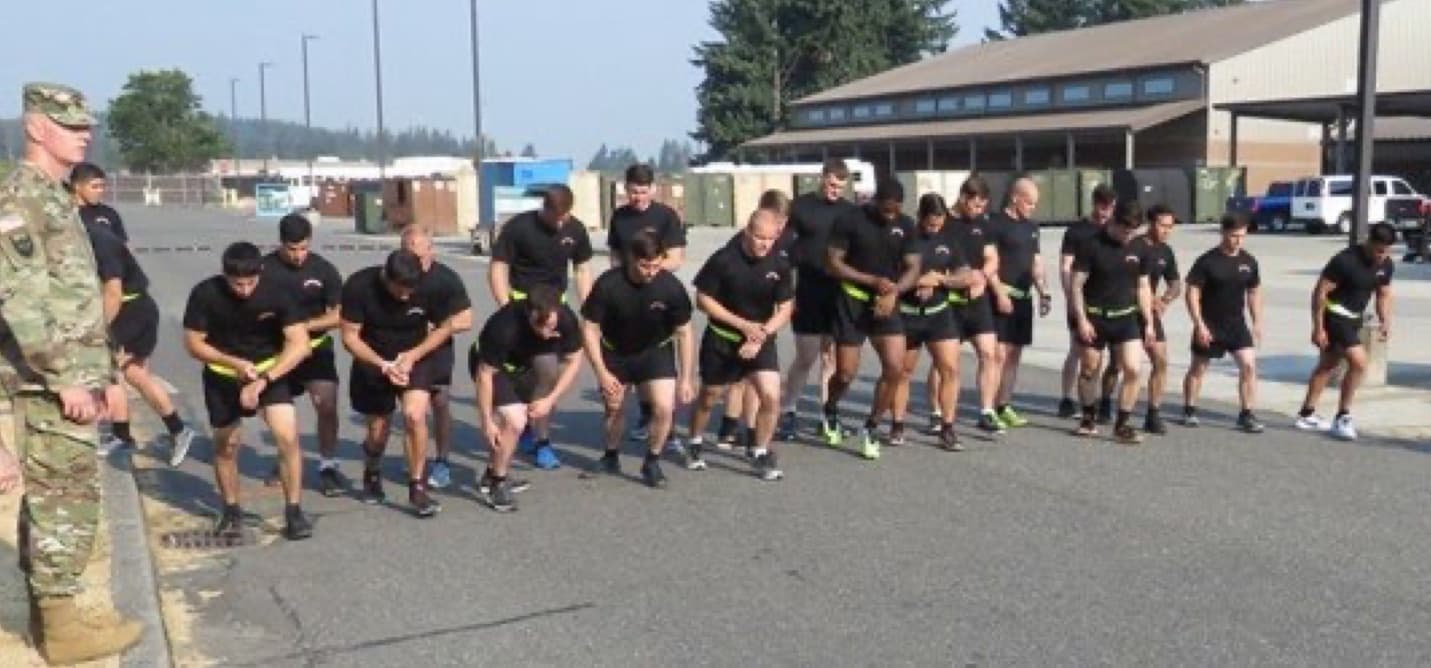
At the start line: Soldiers move up to it when the NCOIC calls "GET READY" at the end of the 10-minute rest. The ATP does not prescribe a body position.
Steps
Step 1: Start“GO”
- Begin running at your own pace when the NCOIC says "GO."
Step 2: Run the course
- Complete the full 2-mile distance on the course. On a track, graders count completed laps.
Step 3: Finish
- Your time is recorded as you cross the finish line at the 2-mile point. Sign your scorecard after the run.
Proper form and what's allowed
- The run starts no more than 10 minutes after the last Soldier completes the plank.
- Walking or pausing.
- Pacing another Soldier or being paced by another Soldier.
- Verbal encouragement.
- Biometric devices such as watches, heart rate monitors, step counters, and fitness trackers.
- Gloves that conform to AR 670-1 may be worn for any event.
Breathing: ATP 7-22.01 gives no breathing guidance for this event, so none is given here.
ATP 7-22.01 (12 Mar 2026), para. 2-75, p. 36; ATP 7-22.01 (12 Mar 2026), para. 2-75, 2-78 – 2-80, p. 36–37
Common mistakes and invalid repetitions
Repetitions or positions that don't count
- Receiving physical help: a Soldier cannot be picked up, pulled, or pushed in any way.
Termination
- Leaving the running course at any time before completing the 2-mile distance.
ATP 7-22.01 (12 Mar 2026), para. 2-78, p. 37
Completion, attempts, timing, and rest
- The raw score is the time recorded when the Soldier crosses the finish line at the 2-mile point.
ATP 7-22.01 (12 Mar 2026), para. 2-79, p. 37
Grader instructions
- During the 10-minute rest, graders issue numbers or vests to their Soldiers.
- On a track, graders record each Soldier's completed laps.
- The NCOIC announces elapsed time as Soldiers finish; graders enter the time on DA Form 705-TEST.
- Graders make sure Soldiers sign their scorecards after the run.
Commands and grader responsibilities
| Command | Who and what happens |
|---|---|
| GET READY | NCOIC, at the end of the 10-minute rest: Soldiers move to the start line. |
| GET SET | NCOIC. |
| GO | NCOIC: Soldiers start and the timer starts the clock. |
| Finish-line time calls | The timer calls minutes and seconds as Soldiers approach the finish (for example, "FOURTEEN-FIFTY-EIGHT, FOURTEEN-FIFTY-NINE, FIFTEEN MINUTES"), and at each lap on a track. |
Grader responsibilities
- After the run, the OIC, NCOIC, or grader converts raw scores to points for every event, enters the total, and confirms scores with the Soldier.
ATP 7-22.01 (12 Mar 2026), para. 2-12, 2-75, 2-79, p. 18–19, 36–37; ATP 7-22.01 (12 Mar 2026), para. 2-75 – 2-76, p. 36
Safety
- Select a course free of significant hazards such as traffic, slippery road surfaces, and heavy air pollution.
- Plan so that weather and environmental conditions do not degrade performance and the uniform suits the conditions.
ATP 7-22.01 (12 Mar 2026), para. 2-8, 2-19, p. 18–20
Scoring and training
Raw score: Time to complete 2 miles (mm:ss). Lower (faster) is better. Points run from 0 to 100 using the June 2025 score tables, by age group and, for the general standard, sex.
Both the general and combat standards require at least 60 points on this event; the combat standard also requires a total of at least 350.
Prepare with the exercise library
The ATP starts every AFT with the Preparation Drill and ends with the Recovery Drill.
Exercises RuckOn maps to this event (an app mapping, not an Army designation):
Muscles and movement (RuckOn explanation)
RuckOn anatomical explanation for training purposes. The Army's own description is in “What it measures and why.”
- Primary
- Heart and lungs (cardiorespiratory system), Quadriceps, Hamstrings, Calves
- Secondary
- Gluteal muscles, Hip flexors, Trunk muscles
- Movement patterns
- Sustained running, Pacing
ATP 7-22.01 (12 Mar 2026), para. 2-30, p. 23; AFT Scoring Scales effective 1 June 2025
Demonstration and sources
U.S. Army Holistic Health and Fitness (YouTube)
Official U.S. Army Holistic Health and Fitness video linked from army.mil/aft. It was titled for the ACFT and may predate the June 2025 AFT and the March 2026 ATP; where anything differs, follow ATP 7-22.01 (March 2026). RuckOn has not reviewed the video frame by frame.
Photos and illustrations: ATP 7-22.01, Holistic Health and Fitness Testing (U.S. Army, 12 March 2026). Approved for public release; distribution is unlimited.
Source notes
Where the official text is inconsistent, it is reported here rather than resolved:
- The official video linked from army.mil/aft is titled "AFT Event 6", from the earlier six-event numbering; the 2-mile run is the fifth AFT event.
- ATP 7-22.01, Holistic Health and Fitness Testing(opens in a new tab)
12 March 2026. Current. Supersedes ATP 7-22.01, 1 October 2020.
- AFT Scoring Scales, Army Fitness Test Score Tables(opens in a new tab)
Approved 15 May 2025, effective 1 June 2025. Listed as the current AFT scoring tables on army.mil/aft when checked.
- army.mil/aft, Army Fitness Test website(opens in a new tab)
Checked 2 October 2026. The ATP names this site for event descriptions and instructional videos.
- Army Directive 2026-07, Army Physical Fitness Standards(opens in a new tab)
17 April 2026 (armypubs record date). Active. Supersedes Army Directive 2025-06 in part and controls where it conflicts with other Army regulations or directives.
Content checked against the publications on 2026-10-02.
RuckOn Fitness is not affiliated with or endorsed by the U.S. Army, and this guide is not a grader certification. Test administration follows ATP 7-22.01 and your unit's OIC or NCOIC.
For OICs, NCOICs, and graders
Field setup
Equipment checklist and specifications, lane and field dimensions, the SDC lane and sequence, 2-mile course requirements, timing and rest rules, grader roles, safety, and setup and close-out checklists.
Open field setupAbout the test
Five events, in order, on the same day: 3 Repetition Maximum Deadlift, Hand-Release Push-Up, Sprint-Drag-Carry, Plank, and 2-Mile Run.
ATP 7-22.01 (12 Mar 2026), para. 2-5, 2-34, p. 17, 25
The AFT predicts a Soldier's ability to perform warrior tasks and high-demand common Soldier tasks, and assesses muscular strength and endurance, aerobic and anaerobic endurance, explosive power, speed, agility, flexibility, balance, and coordination.
ATP 7-22.01 (12 Mar 2026), para. 2-2, p. 17
Soldiers must attempt all five events and cannot stop after failing one. Failing to reach the minimum on any event is a test failure.
ATP 7-22.01 (12 Mar 2026), para. 2-31, 2-35, p. 23, 25
Soldiers must not start the test if they are ill, injured, or on a temporary profile that limits them physically; starting the test acknowledges readiness.
ATP 7-22.01 (12 Mar 2026), para. 2-31, p. 23
Results are recorded on DA Form 705-TEST, which the Soldier signs to confirm the raw scores.
ATP 7-22.01 (12 Mar 2026), para. 2-30, 2-32, p. 23
Standards
General standard: sex- and age-normed; at least 60 points on each event.
ATP 7-22.01 (12 Mar 2026), para. 2-30, p. 23
Combat standard: sex-neutral and age-normed; at least 60 points on each event and a total of at least 350.
ATP 7-22.01 (12 Mar 2026), para. 2-30, p. 23
Combat specialties per Army Directive 2026-07: 11A, 11B, 11C, 11Z, 12A, 12B, 12D, 13A, 13F, 180A, 18A, 18B, 18C, 18D, 18E, 18F, 18Z, 19A, 19C, 19D, 19K, 19Z, 89D, and 89E. The directive adds 12D, 89D, and 89E to the list in the ATP and controls where it conflicts with other guidance.
Army Directive 2026-07, para. 4b(2) and enclosure 2
Army Directive 2026-07 also adds a separate pass/fail Combat Field Test for combat specialties. It is not a substitute for the AFT and is not covered in this guide.
Army Directive 2026-07, para. 4a
Test day at a glance
- 1
Instructions and scorecards
Before the Preparation Drill is completed, supervisors read the AFT, scorecard, and conclusion instructions aloud and hand out DA Form 705-TEST.
- 2
Preparation Drill
Starts the 2-hour clock. Led by an instructor who is not testing; Soldiers perform it at their own pace.
- 3
MDL warm-up (10 minutes)
Recommended graduated sets, then Soldiers stack behind the weight they intend to lift.
- 4
1. 3 Repetition Maximum Deadlift
Two attempts per Soldier.
- 5
2. Hand-Release Push-Up
Soldiers rotate in stacks of four with a common start for each group.
- 6
3. Sprint-Drag-Carry
Two graders per pair of adjacent lanes.
- 7
4. Plank
When the last Soldier finishes, the 10-minute rest starts.
- 8
10-minute rest
Graders issue numbers or vests; Soldiers move to the run start line.
- 9
5. 2-Mile Run
Starts at the end of the 10 minutes. The 2-hour limit ends at the start of the run.
- 10
Recovery Drill
After all events, as a group or individually.
ATP 7-22.01 (12 Mar 2026), paras 2-26 – 2-40, 2-75, pp. 22–25, 36
Practice the Preparation Drill and Recovery Drill in the exercise library.
Sources and currency
Checked on 2026-10-02. ATP 7-22.01 (12 March 2026) supersedes the October 2020 edition. Army Directive 2026-07 supersedes Army Directive 2025-06 in part. The June 2025 score tables were still listed as current on army.mil/aft.
- ATP 7-22.01, Holistic Health and Fitness Testing(opens in a new tab)
12 March 2026. Current. Supersedes ATP 7-22.01, 1 October 2020.
- Army Directive 2026-07, Army Physical Fitness Standards(opens in a new tab)
17 April 2026 (armypubs record date). Active. Supersedes Army Directive 2025-06 in part and controls where it conflicts with other Army regulations or directives.
- AFT Scoring Scales, Army Fitness Test Score Tables(opens in a new tab)
Approved 15 May 2025, effective 1 June 2025. Listed as the current AFT scoring tables on army.mil/aft when checked.
- army.mil/aft, Army Fitness Test website(opens in a new tab)
Checked 2 October 2026. The ATP names this site for event descriptions and instructional videos.
Alternate aerobic events for Soldiers on permanent profiles are not covered in this guide.
RuckOn Fitness is not affiliated with or endorsed by the U.S. Army, and this guide is not a grader certification. Test administration follows ATP 7-22.01 and your unit's OIC or NCOIC.