
Supine Chest Press
Lying on your back with knees bent, press a kettlebell in each hand from the shoulders to straight arms.
Demonstration
Official photo sequences from the Army's drill manual, read left to right, top to bottom.
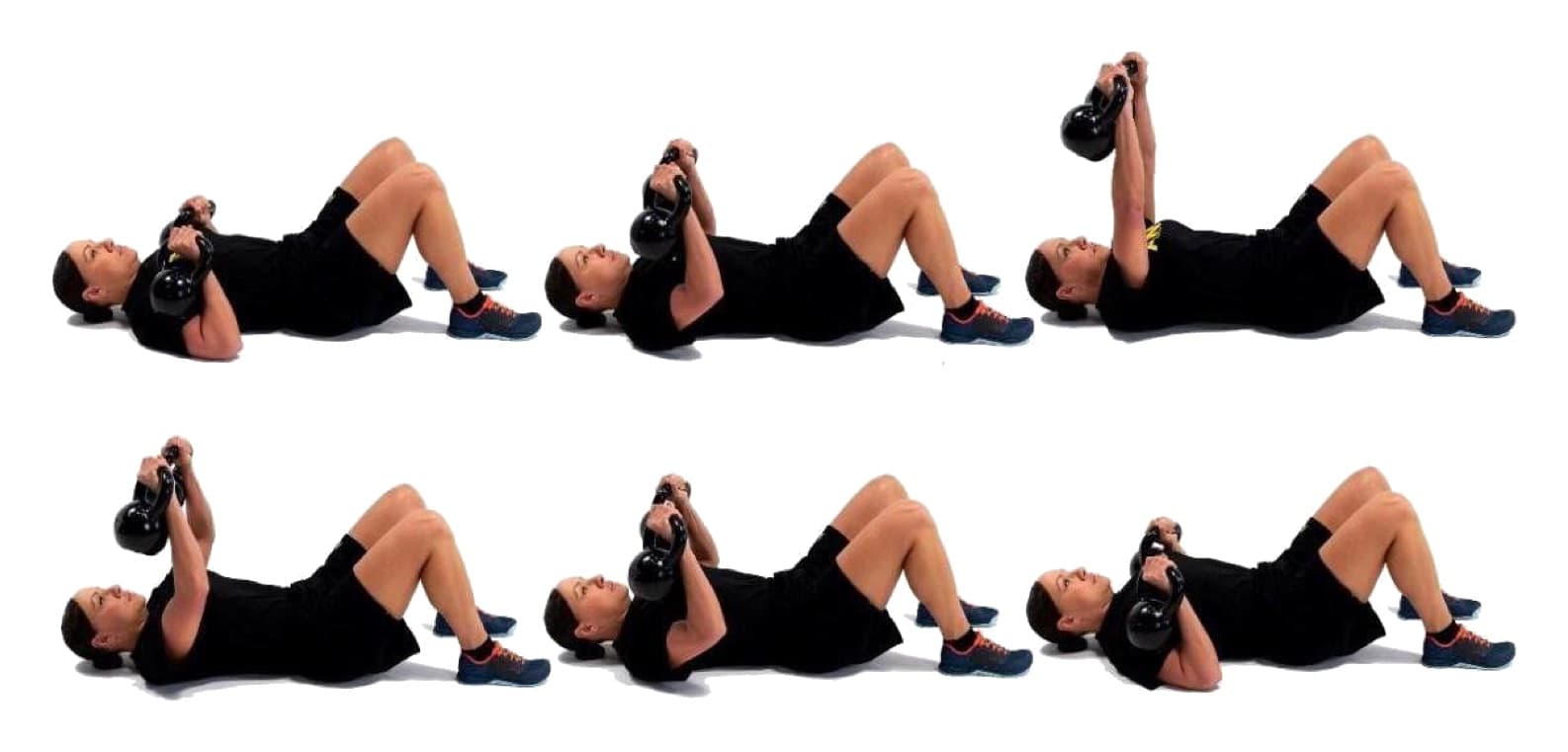
Photos: U.S. Army Center for Initial Military Training, ATP 7-22.02. Approved for public release.
How to perform it
Strength Training Circuit, station 6
Starting position
Supine with the knees bent to 90 degrees, feet 8–12 inches apart and flat on the ground, head and upper arms resting on the ground. Hold a kettlebell of the same weight in each hand with a closed, partly pronated grip, elbows bent so the kettlebells rest on the front of the shoulders.
Supine: Lying on the back with legs together and the body aligned, reached from the Straddle Stance through Half-Kneeling and Sitting without using the hands. ATP 7-22.02, para. 2-8 – 2-10, p. 2-3 – 2-4 (opens the official PDF)
Movement
- 1Press. Extend the elbows to raise the kettlebells straight up in front of the shoulders, turning the hands to a fully pronated grip.
- 2Lower. Return to the starting position.
- 3Continue. Continue at your own pace for the station's minute.
ATP 7-22.02, para. 13-9, p. 13-7, Figure 13-7 (opens the official PDF)
What it develops
Strengthens the chest, shoulder, and triceps muscles and develops the ability to push during combatives, testing, and combat tasks; the sixth station of the Strength Training Circuit.
Focus: Chest, Shoulders, Triceps
Form
Drawn from the cited instructions.
Cues
- Press the kettlebells straight up in front of the shoulders.
Cautions
- Change the kettlebell weight if needed, and continue only while the press can be done to standard.
Substitutions
Alternatives described in the cited publication, and how they differ.
- Bench Press — Presses from a bench with a longer range of motion and heavier loads; a straight bar needs a rack and a spotter. ATP 7-22.02, para. 14-10, p. 14-6 (opens the official PDF)