
Front Squat
Holding the weight at the front of the shoulders, squat until the knees reach 90 degrees, then stand back up.
Demonstration
Official photo sequences from the Army's drill manual, read left to right, top to bottom.
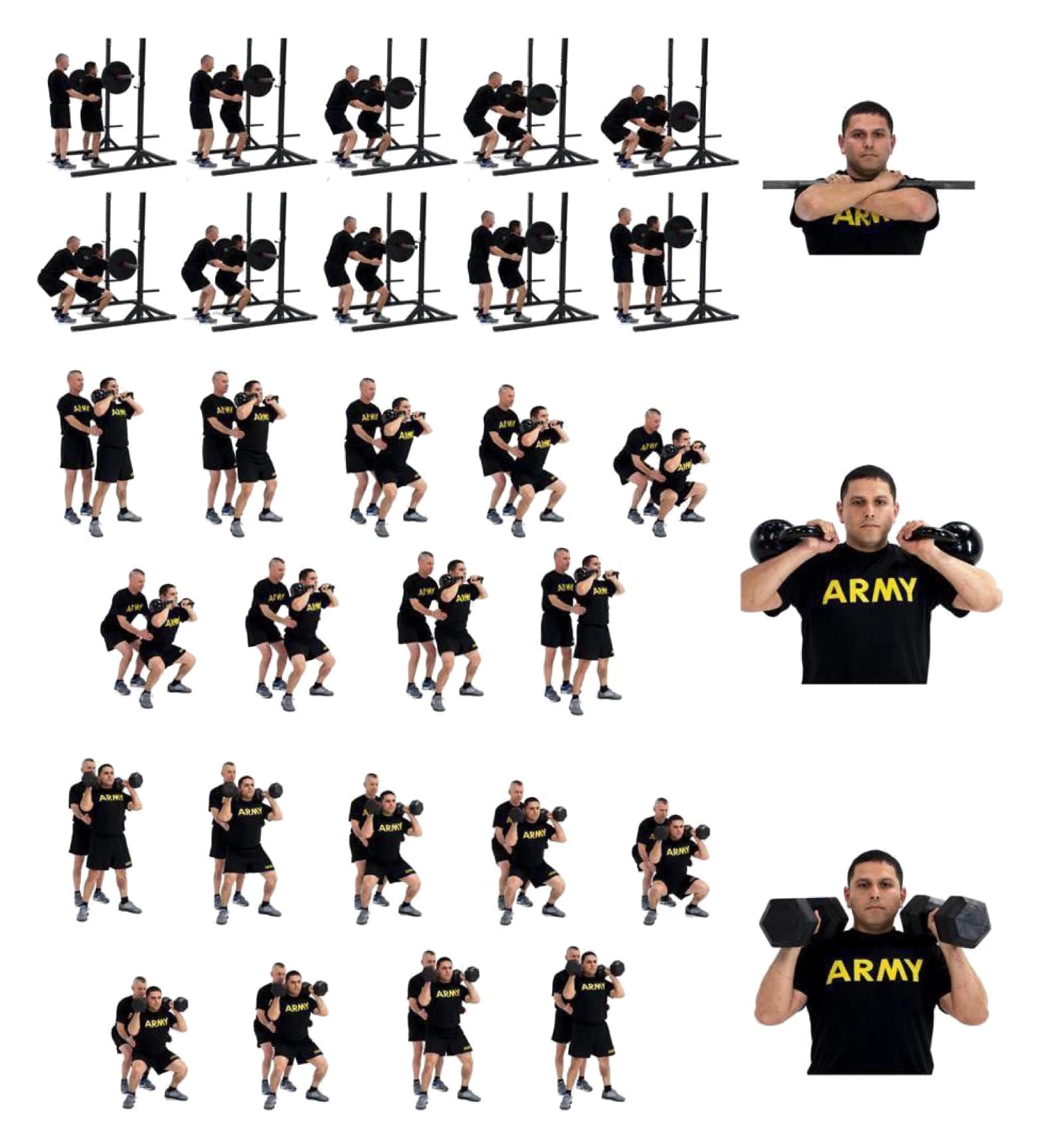
Photos: U.S. Army Center for Initial Military Training, ATP 7-22.02. Approved for public release.
How to perform it
Free Weight Training (core exercise)
Starting position
Straddle Stance with the toes pointed slightly outward. Hold a bar across the top of the chest just below the collarbones with crossed arms and a pronated grip. Kettlebells are held in the rack position; dumbbells rest on top of the shoulders.
Straddle Stance: Stand with the feet pointing ahead and shoulder-width apart. ATP 7-22.02, para. 2-5, p. 2-3 (opens the official PDF)
Movement
- 1Lower. Bend the knees and slowly lower the body until there is a 90-degree angle between the upper and lower leg.
- 2Stand. Return to the starting position.
- 3Repeat. Repeat for the session's repetitions and sets.
ATP 7-22.02, para. 14-4, p. 14-1 – 14-2, Figure 14-1 (opens the official PDF)
What it develops
A Free Weight Core exercise used throughout a Soldier's career to improve lower-body muscular strength and endurance, and to improve training and testing performance.
Focus: Thighs, Hips, Trunk
Form
Drawn from the cited instructions.
Cues
- Keep the knees aligned over the feet and the heels on the ground.
- Progress to deeper squat positions as strength improves.
Common mistakes
- Rounding the upper back.
Cautions
- Use a spotter, who stands behind the lifter with the hands close to, but not touching, the lifter's trunk and moves with the lifter (para. 14-5).
- Always lift a weight that can be controlled throughout the range of motion.
Substitutions
Alternatives described in the cited publication, and how they differ.
- Back Squat — The bar rests across the upper back, or a weight is held at each side, instead of in front of the shoulders. ATP 7-22.02, para. 14-6, p. 14-3 (opens the official PDF)
- Sumo Squat — One kettlebell held in front with a wider, toes-out stance; done for time in the Strength Training Circuit. ATP 7-22.02, para. 13-3, p. 13-1 (opens the official PDF)