
Event 3 of 5
Sprint-Drag-Carry
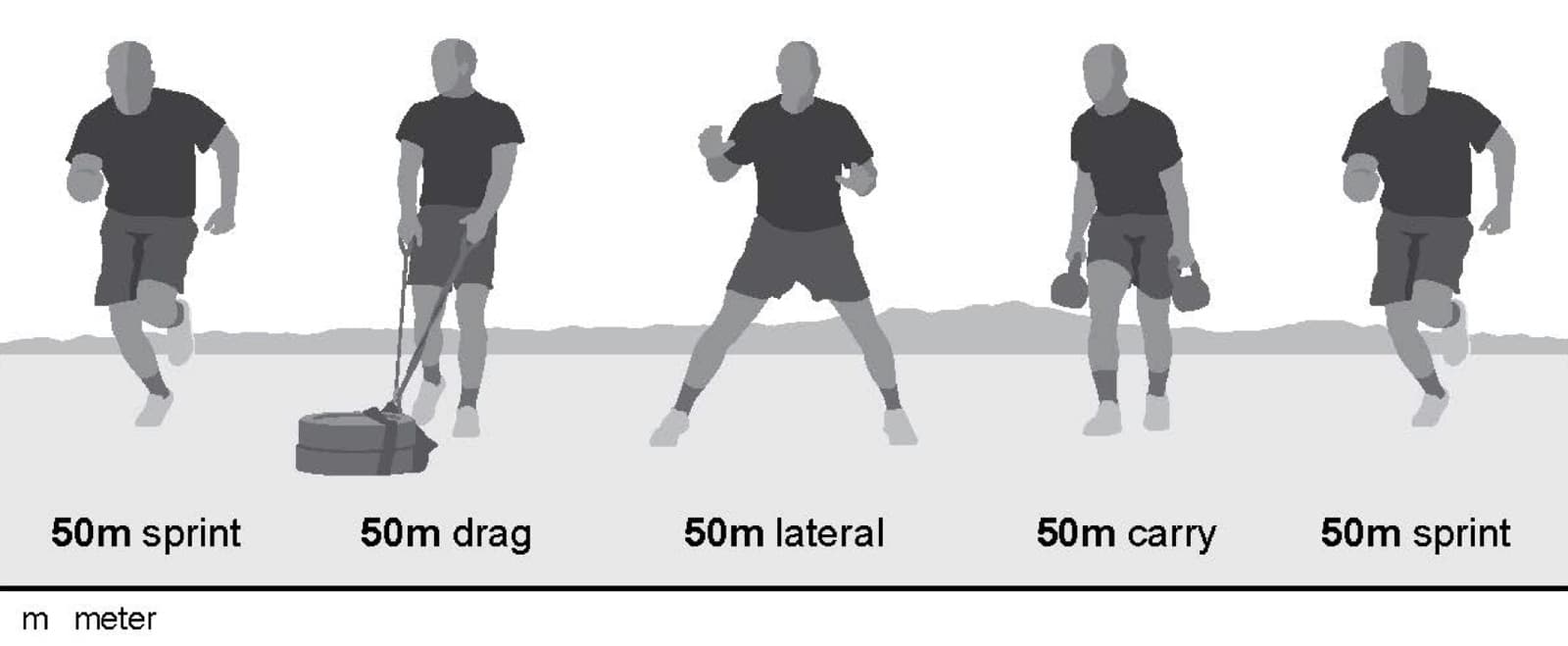
A timed 250-meter shuttle event (5 × 50 meters) that measures anaerobic capacity, muscular endurance, and muscular strength.
What it measures and why
A timed 250-meter shuttle event (5 × 50 meters) that measures anaerobic capacity, muscular endurance, and muscular strength.
The Army describes these as the capacities needed for high-intensity tasks lasting a few seconds to a few minutes, such as reacting to direct and indirect fire, building a hasty fighting position, and extracting a casualty and carrying them to safety.
Army-named fitness components: Anaerobic capacity, Muscular endurance, Muscular strength.
ATP 7-22.01 (12 Mar 2026), para. 2-67, p. 33
Equipment and station setup
Equipment per lane
- 1 × Nylon sled with pull strap — Sled 22 × 19.5 inches, holds up to four 45-pound plates; one-piece strap 92 inches (±2) with a loop handle at each end.
- 2 × 45-pound bumper plates on the sled — Four plates (180 pounds) on a modified surface.
- 2 × 40-pound kettlebells — Within 2 pounds of 40 pounds, about 11 inches (±1) tall, flat base so the handle stands vertical.
- 2 × Stopwatches — OIC or NCOIC and the lane grader; the start-line grader may use one or two to time both Soldiers in adjacent lanes.
Station setup
- Lanes are 25 meters long and 2.5–3.0 meters wide, marked every 5 meters, with about 4 meters past the 25-meter line for the sled turn-around and about 8 meters behind the start line for staging and the finish.
- Use a standard surface (maintained grass or artificial turf, two 45-pound plates on the sled) when possible. On a modified surface (wood, packed dirt, vinyl, or smooth concrete) the OIC or NCOIC puts four 45-pound plates on the sled.
- Do not use restricted surfaces: unimproved dirt or gravel, rubberized track or gym floors, ice, or snow.
- Indoor lanes need enough space at both ends to turn and to sprint through the finish.
- Inspect the sled and pull strap for torn fabric or stitching.
- On "GET READY," each Soldier arranges the SDC equipment at the start line.
ATP 7-22.01 (12 Mar 2026), para. 2-23; E-9 – E-14, p. 21–22, 89–90; ATP 7-22.01 (12 Mar 2026), para. 2-16 – 2-18, 2-66; E-10 – E-11, E-29; equipment safety note, p. 19–20, 32, 89, 93
How to perform it
Starting position
Prone with the hands on the ground beneath the shoulders and the top of the head behind the start line.
Steps
Step 1: Shuttle 1: sprint“GO”
- Get up from the prone position and sprint 25 meters. Touch the 25-meter line with a foot and a hand, turn, and sprint back to the start.
Step 2: Shuttle 2: drag
- Grasp each strap handle and pull the sled backward until the whole sled crosses the 25-meter line, then turn and drag it back to the start line.
- The strap must pass freely through the sled's D-ring and may not be twisted, wrapped, or knotted.
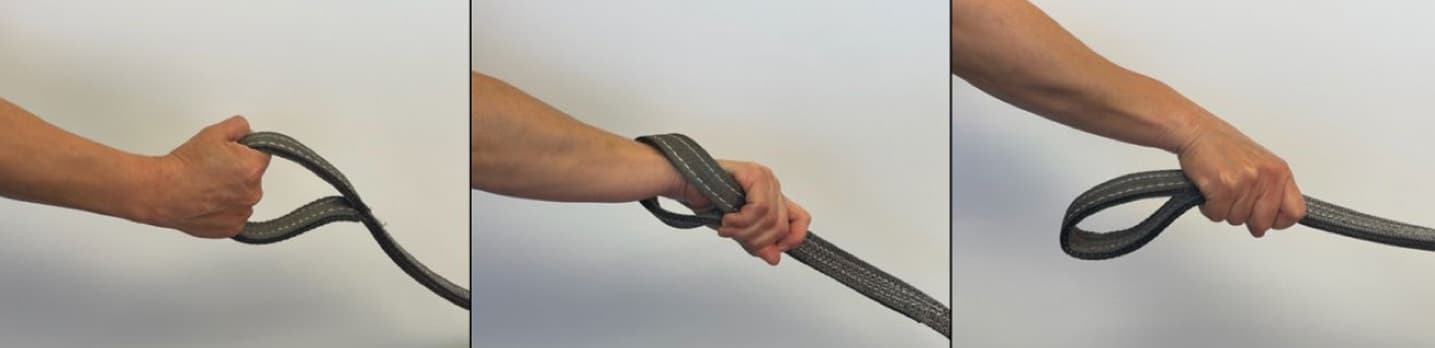
Figure 2-11. Authorized strap handle grips · ATP 7-22.01, p. 33 (PDF) opens the official publication in a new tab Step 3: Shuttle 3: lateral
- Move laterally 25 meters leading with one foot, touch the 25-meter line with a foot and a hand, and return leading with the other foot.
- Face the same direction out and back. The feet do not cross and stay parallel to each other and perpendicular to the direction of travel.
Step 4: Shuttle 4: carry
- Pick up both 40-pound kettlebells with a closed grip and carry them at your sides (farmer's carry only). Run 25 meters, touch the 25-meter line with a foot, and return.
- Keep the kettlebells upright with the handles up. After crossing the start line, set them down without dropping them.
Step 5: Shuttle 5: sprint
- Sprint 25 meters, touch the 25-meter line with a foot and a hand, then sprint back across the start line to finish.
Proper form and what's allowed
- Three sled-strap grips only: fingers through the loops; hands completely through the loops gripping just below the sewn portion; or gripping below the loops at the sewn portion.
- Leading with either foot on the first lateral leg (then the other foot on the way back).
- Gloves that conform to AR 670-1 may be worn for any event.
Breathing: ATP 7-22.01 gives no breathing guidance for this event, so none is given here.
ATP 7-22.01 (12 Mar 2026), para. 2-68, 2-70, p. 33–34
Common mistakes and invalid repetitions
Call-backs
- Not touching the 25-meter line with a foot and a hand on the sprints and lateral: the grader calls the Soldier back to do so.
- Not getting the whole sled across the 25-meter line: the grader calls the Soldier back.
- Not touching the 25-meter line with a foot on the carry: the grader calls the Soldier back.
- Dropping the kettlebells at the start line: the grader calls the Soldier back to set them down under control.
Termination
The ATP lists no termination criteria for this event.
ATP 7-22.01 (12 Mar 2026), para. 2-68, p. 33–34
Completion, attempts, timing, and rest
- The event is five continuous 50-meter shuttles in order: sprint, drag, lateral, carry, sprint.
- The start-line grader records the time after both Soldiers in the adjacent lanes cross the finish line.
ATP 7-22.01 (12 Mar 2026), para. 2-68 – 2-70, p. 33–34
Grader instructions
- Two graders work together across two adjacent lanes and stay at the ends of the lanes; they do not run with the Soldiers.
- The start-line grader starts and records the time for both Soldiers and enforces standards at the start line.
- The 25-meter grader confirms correct foot and hand touches and that the sled crosses the line.
Commands and grader responsibilities
| Command | Who and what happens |
|---|---|
| GET READY | NCOIC: the first Soldier in each lane arranges the equipment and takes the ready position. |
| GRADERS READY | NCOIC; graders signal visually. |
| GET SET | NCOIC: Soldiers take the prone start position. |
| GO | NCOIC: the start-line grader starts the stopwatch. |
| NEXT SOLDIER, MOVE FORWARD | NCOIC, once all lanes finish. |
Grader responsibilities
- Call Soldiers back to fix a missed touch or a sled that did not cross the line.
- Record the SDC time on DA Form 705-TEST.
ATP 7-22.01 (12 Mar 2026), para. 2-12 – 2-13, 2-65 – 2-66, 2-69, p. 18–19, 32, 34; ATP 7-22.01 (12 Mar 2026), para. 2-66, p. 32
Safety
- Each grader controls two adjacent lanes to keep Soldiers and graders safe and to prevent interference between lanes.
- Choose the safest surface; standard surfaces should be the primary choice. No adjustments to SDC standards or scoring are authorized other than the sled weight for a modified surface.
- Check the sled and strap for torn fabric or stitching before the test.
ATP 7-22.01 (12 Mar 2026), para. 2-12, 2-18; E-11; equipment safety note, p. 19–20, 89
Scoring and training
Raw score: Total time (mm:ss). Lower (faster) is better. Points run from 0 to 100 using the June 2025 score tables, by age group and, for the general standard, sex.
Both the general and combat standards require at least 60 points on this event; the combat standard also requires a total of at least 350.
Prepare with the exercise library
The ATP starts every AFT with the Preparation Drill and ends with the Recovery Drill.
Exercises RuckOn maps to this event (an app mapping, not an Army designation):
- Forward Lunge
- Lateral
- Shuttle Sprint
- Mountain Climber
- Turn and Lunge
- Half Jack
- Half-Squat Laterals
- 8-Count Step-Up
- Heel Raise
Muscles and movement (RuckOn explanation)
RuckOn anatomical explanation for training purposes. The Army's own description is in “What it measures and why.”
- Primary
- Quadriceps, Gluteal muscles, Hamstrings, Calves
- Secondary
- Hip abductors and adductors (lateral), Grip, forearm, and trapezius muscles (drag and carry), Trunk muscles
- Movement patterns
- Sprinting and turning, Backward sled drag, Lateral movement, Loaded carry, Getting up from the ground quickly
ATP 7-22.01 (12 Mar 2026), para. 2-30, p. 23; AFT Scoring Scales effective 1 June 2025
Demonstration and sources
U.S. Army Holistic Health and Fitness (YouTube)
Official U.S. Army Holistic Health and Fitness video linked from army.mil/aft. It was titled for the ACFT and may predate the June 2025 AFT and the March 2026 ATP; where anything differs, follow ATP 7-22.01 (March 2026). RuckOn has not reviewed the video frame by frame.
Photos and illustrations: ATP 7-22.01, Holistic Health and Fitness Testing (U.S. Army, 12 March 2026). Approved for public release; distribution is unlimited.
Source notes
Where the official text is inconsistent, it is reported here rather than resolved:
- The ATP lists call-backs for missed touches but does not list termination criteria for the SDC.
- The restricted-surface list in para. 2-17 includes "rubberized track or gym floors"; the list in para. E-10 names only rubberized track.
- ATP 7-22.01, Holistic Health and Fitness Testing(opens in a new tab)
12 March 2026. Current. Supersedes ATP 7-22.01, 1 October 2020.
- AFT Scoring Scales, Army Fitness Test Score Tables(opens in a new tab)
Approved 15 May 2025, effective 1 June 2025. Listed as the current AFT scoring tables on army.mil/aft when checked.
- army.mil/aft, Army Fitness Test website(opens in a new tab)
Checked 2 October 2026. The ATP names this site for event descriptions and instructional videos.
- Army Directive 2026-07, Army Physical Fitness Standards(opens in a new tab)
17 April 2026 (armypubs record date). Active. Supersedes Army Directive 2025-06 in part and controls where it conflicts with other Army regulations or directives.
Content checked against the publications on 2026-10-02.
RuckOn Fitness is not affiliated with or endorsed by the U.S. Army, and this guide is not a grader certification. Test administration follows ATP 7-22.01 and your unit's OIC or NCOIC.