
Event 1 of 5
3 Repetition Maximum Deadlift
Measures the lower-body muscular strength needed to lift heavy loads from the ground safely and effectively.
What it measures and why
Measures the lower-body muscular strength needed to lift heavy loads from the ground safely and effectively.
The Army describes the MDL as a strong predictor of a Soldier's ability to lift and carry a casualty on a litter and to lift and move personnel and equipment. It relies on well-conditioned back and leg muscles that help with load carriage and with avoiding upper- and lower-back injuries.
Army-named fitness components: Lower-body muscular strength.
ATP 7-22.01 (12 Mar 2026), para. 2-41, p. 26
Equipment and station setup
Equipment per lane
- 1 × Hexagon (hex) bar, 60 pounds unloaded — One per lane. Other bar weights are allowed if the bar is weighed and plate loads are recalculated.
- 2 × Barbell collars — Not counted in the load.
- Bumper plates — Loaded to the lane's weight using the ATP's plate arrangement table (120 to 340 pounds).
Station setup
- Set up MDL lanes in the space next to the field lanes.
- Weigh each hex bar before the test and load plates using the ATP's plate arrangement table. Recalculate if a bar is not 60 pounds.
- Inspect hex bars for stress cracks at the welded seams.
- Aim for 5–6 Soldiers per MDL lane; graders may change bar weights or move Soldiers to even out the stacks.
- Soldiers choose a lane with their preferred starting weight.
ATP 7-22.01 (12 Mar 2026), para. 2-21, Table 2-1; E-2 – E-8, p. 20–21, 87–89; ATP 7-22.01 (12 Mar 2026), para. 2-43; E-3, E-6, E-30; equipment safety note, p. 20, 26, 87–88, 93
How to perform it
Starting position
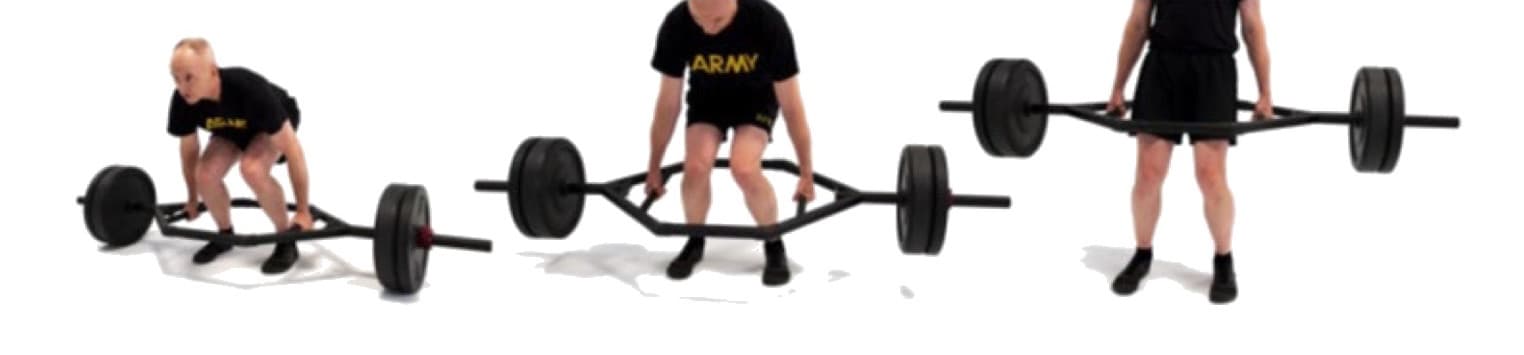
Inside the hex bar with feet shoulder-width apart, gripping the center of the handles with a closed grip. Arms fully extended, back flat, head in line with the spine or slightly extended, and both heels on the ground. Every repetition starts from this position.
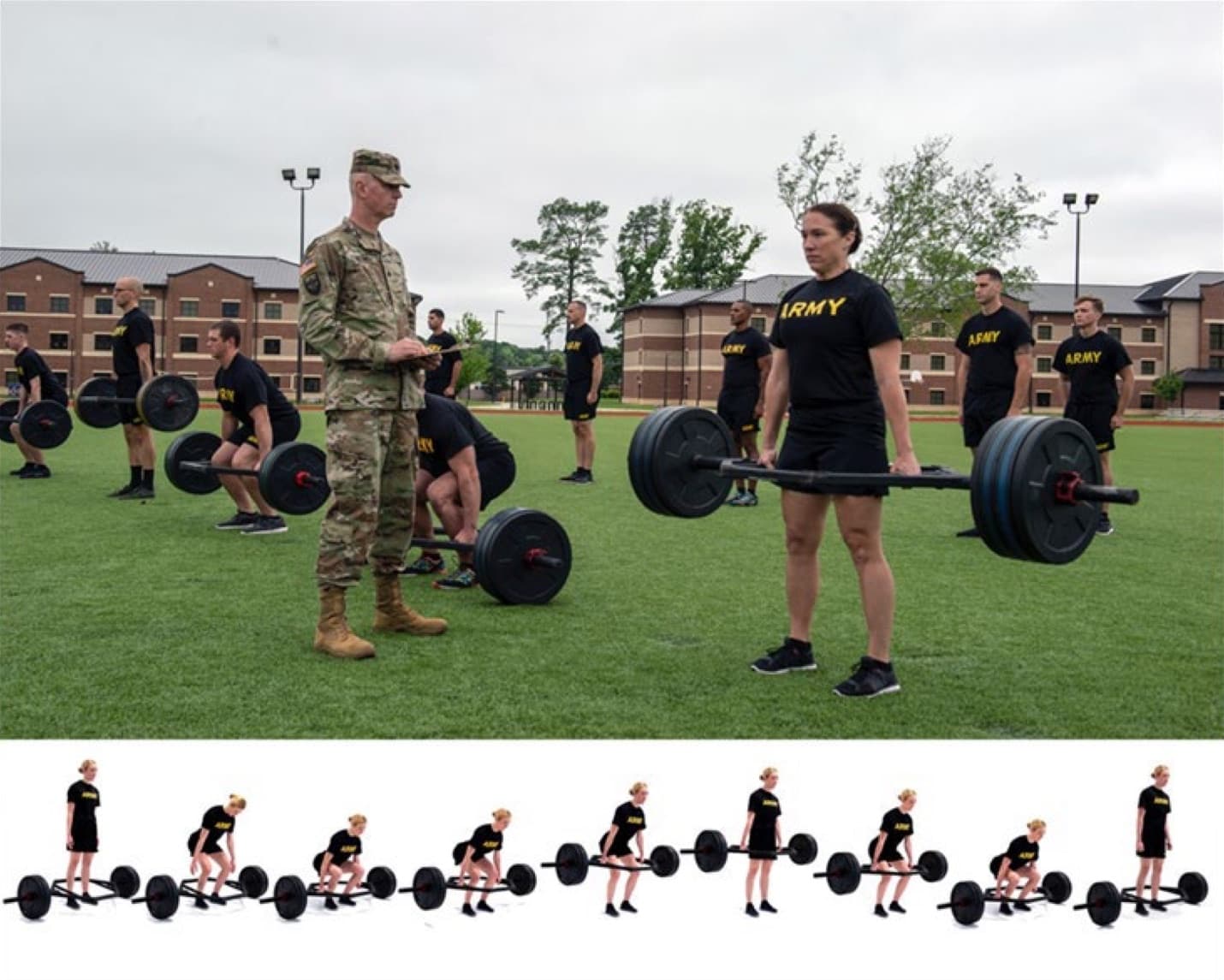
Steps
Step 1: Prepare“GET SET”
- Step inside the hex bar, feet shoulder-width apart, and find the mid-point of the handles.
- Bend at the knees and hips, reach down, and grasp the center of the handles with a closed grip (thumb wrapped around the handle opposite the fingers).
Step 2: Lift“GO”
- Straighten the hips and knees to stand up into the Straddle Stance.
- Do not let the hips rise before or above the shoulders. Keep the back straight and the feet in place, staying balanced and in control.
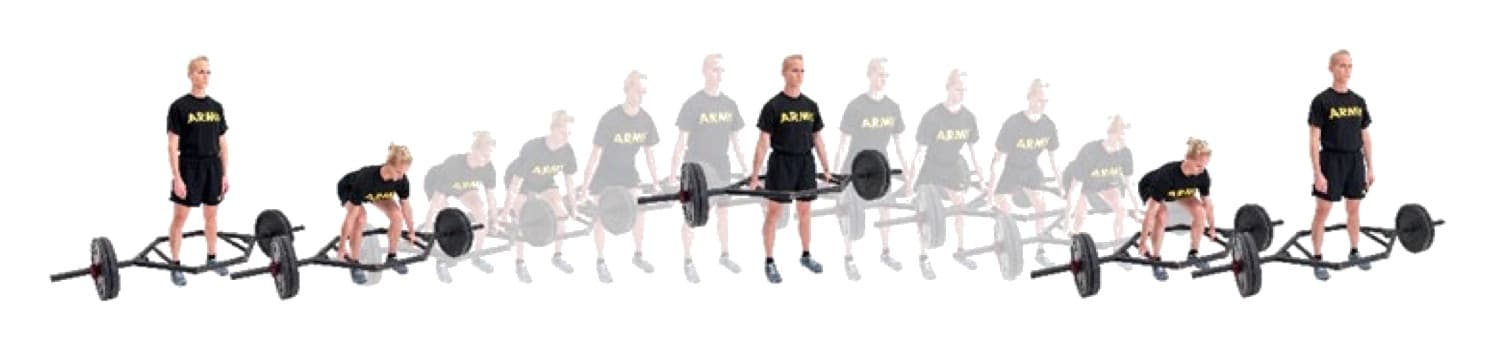
Figure 2-4. Proper technique to execute the Maximum Deadlift · ATP 7-22.01, p. 27 (PDF) opens the official publication in a new tab Step 3: Lower
- Lower the bar to the ground under control with a straight back.
- Place the bar down; do not drop it. The plates must touch the ground to finish the repetition.
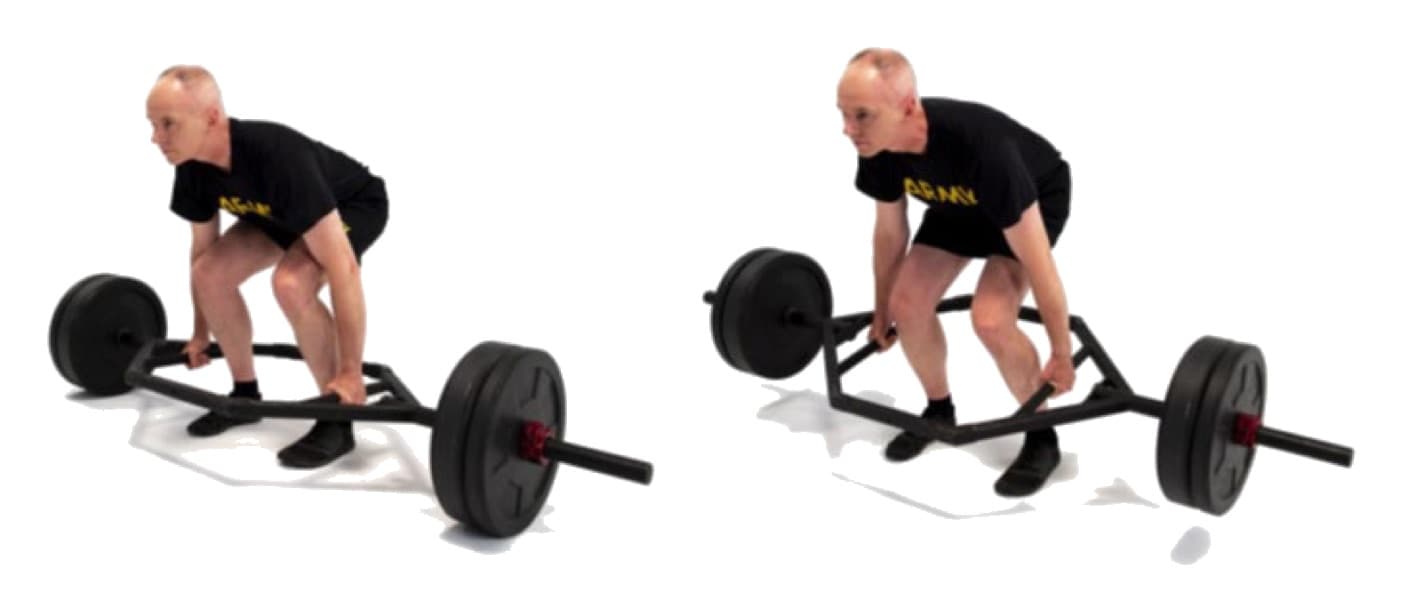
Figure 2-7. Touching the plates to the ground versus not touching the ground · ATP 7-22.01, p. 29 (PDF) opens the official publication in a new tab Step 4: Repeat
- Complete three continuous repetitions without resting on the ground.
Proper form and what's allowed
- Recommended 10-minute MDL warm-up: 8–10 reps at 25% of goal weight or the empty bar (rest 2 min), 6 reps at 40% (rest 3 min), 4 reps at 50% (rest 4 min or until the event starts), and an optional 1 rep at 80%.
- Adjusting the grip while keeping contact with the bar.
- Moving to another lane that already has the next target weight.
- Hex bars with adjustable handle width and walk-in hex bars.
- Gloves that conform to AR 670-1 may be worn for any event.
Breathing: ATP 7-22.01 gives no breathing guidance for this event, so none is given here.
ATP 7-22.01 (12 Mar 2026), para. 2-45 – 2-46, p. 27; ATP 7-22.01 (12 Mar 2026), para. 2-46, p. 27
Common mistakes and invalid repetitions
Safety stops
- Knees moving closer together during any part of the lift (safety stop).
- Hips rising above the shoulders to start the lift (safety stop).
- Back or shoulders rounding during any part of the lift (safety stop).
- Losing balance, including stepping forward or backward (safety stop).
Termination
- Not fully extending the legs to reach the Straddle Stance.
- Dropping the bar.
- Taking the hands off the bar between repetitions while it is on the ground.
- Not touching the bar to the ground between repetitions.
- Resting on the ground (an obvious lack of effort to lift).
- A safety stop on the second or third repetition.
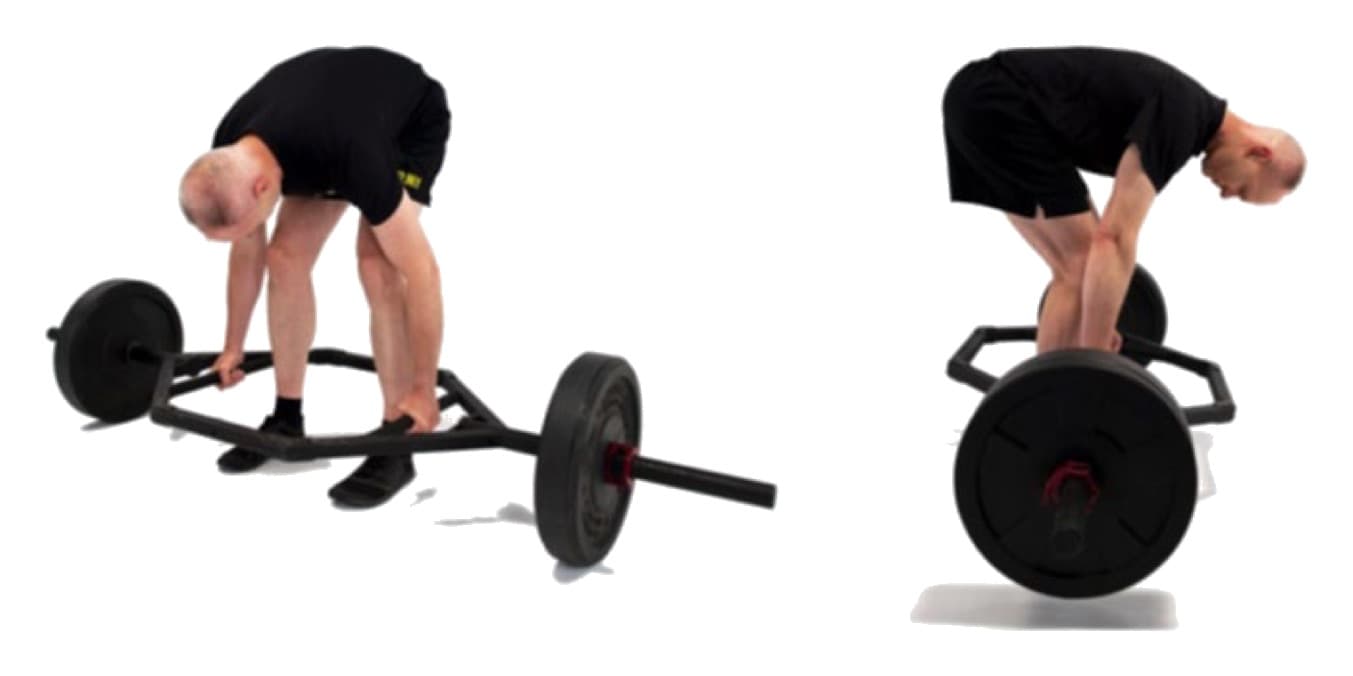
ATP 7-22.01 (12 Mar 2026), para. 2-47 – 2-48, p. 28; ATP 7-22.01 (12 Mar 2026), para. 2-50, p. 28–29
Completion, attempts, timing, and rest
- A successful attempt is 3 continuous repetitions to standard.
- Each Soldier has two attempts. After a successful first attempt, the Soldier may make one attempt at a heavier weight. After a failed first attempt, the Soldier may make one more attempt at the same or a lower weight.
- The raw score is the heaviest weight successfully lifted.
- There is no programmed rest before the next event unless only one or two Soldiers are testing (then 5 minutes).
ATP 7-22.01 (12 Mar 2026), para. 2-37, 2-43, 2-46, 2-48 – 2-52, p. 25–29
Grader instructions
- The grader gives "GET SET" and "GO" for each attempt.
- The grader records each attempt, checks the maximum weight successfully lifted, and initials the MDL box on DA Form 705-TEST.
- The grader returns the scorecard to the Soldier and reports to the OIC or NCOIC for HRP lane assignment.
Commands and grader responsibilities
| Command | Who and what happens |
|---|---|
| GET READY | NCOIC: the first Soldier in each stack stands in front of the hex bar. |
| GRADERS READY | NCOIC, once all Soldiers are ready; graders signal visually. |
| THE MAXIMUM DEADLIFT STARTS NOW | NCOIC. |
| GET SET | Grader: the Soldier steps inside the hex bar into the start position. |
| GO | Grader: starts the attempt. |
| NEXT SOLDIER MOVE FORWARD | Grader, after each Soldier finishes. |
Grader responsibilities
- Call a safety stop on an unsafe first repetition, explain the error, and let the Soldier restart.
- Terminate the attempt and record a failed attempt for a safety stop on the second or third repetition.
- After a successful attempt, record the weight and ask whether the Soldier wants to try a heavier weight.
ATP 7-22.01 (12 Mar 2026), para. 2-12, 2-43, 2-47 – 2-51, p. 18–19, 26–29; ATP 7-22.01 (12 Mar 2026), para. 2-43, p. 26
Safety
- A safety stop on the first repetition is not a record attempt: the grader explains the error and the Soldier restarts the attempt. It exists to prevent repeated movements that could cause injury.
- Collars keep plates from moving during the lift.
- Soldiers should know their goal weight and have lifted it in training before the test.
- Chalk, powder, weightlifting belts, and wrist straps are not authorized.
ATP 7-22.01 (12 Mar 2026), para. 2-21 note, 2-42, 2-47; E-7, p. 21, 26, 28, 88
Scoring and training
Raw score: Heaviest weight lifted for 3 correct repetitions (pounds). Higher is better. Points run from 0 to 100 using the June 2025 score tables, by age group and, for the general standard, sex.
Both the general and combat standards require at least 60 points on this event; the combat standard also requires a total of at least 350.
Prepare with the exercise library
The ATP starts every AFT with the Preparation Drill and ends with the Recovery Drill.
Exercises RuckOn maps to this event (an app mapping, not an Army designation):
- Squat Bender
- Back Bridge
- Sumo Squat
- Straight-Leg Deadlift
- Deadlift
- Single-Leg Deadlift
- Bent-Over Row
- Front Squat
- Back Squat
- Single-Arm Bent-Over Row
Muscles and movement (RuckOn explanation)
RuckOn anatomical explanation for training purposes. The Army's own description is in “What it measures and why.”
- Primary
- Gluteus maximus, Quadriceps, Hamstrings, Spinal erectors
- Secondary
- Forearm and grip muscles, Trapezius, Abdominal and trunk muscles
- Movement patterns
- Hip hinge with knee bend (hex-bar lift), Two-leg lift from the ground, Grip and trunk bracing
ATP 7-22.01 (12 Mar 2026), para. 2-30, p. 23; AFT Scoring Scales effective 1 June 2025
Demonstration and sources
U.S. Army Holistic Health and Fitness (YouTube)
Official U.S. Army Holistic Health and Fitness video linked from army.mil/aft. It was titled for the ACFT and may predate the June 2025 AFT and the March 2026 ATP; where anything differs, follow ATP 7-22.01 (March 2026). RuckOn has not reviewed the video frame by frame.
Photos and illustrations: ATP 7-22.01, Holistic Health and Fitness Testing (U.S. Army, 12 March 2026). Approved for public release; distribution is unlimited.
Source notes
Where the official text is inconsistent, it is reported here rather than resolved:
- The ATP's plate arrangement table goes up to 340 pounds, while the June 2025 score tables award points up to 350 pounds in some age groups. The ATP does not show a 350-pound arrangement.
- ATP 7-22.01, Holistic Health and Fitness Testing(opens in a new tab)
12 March 2026. Current. Supersedes ATP 7-22.01, 1 October 2020.
- AFT Scoring Scales, Army Fitness Test Score Tables(opens in a new tab)
Approved 15 May 2025, effective 1 June 2025. Listed as the current AFT scoring tables on army.mil/aft when checked.
- army.mil/aft, Army Fitness Test website(opens in a new tab)
Checked 2 October 2026. The ATP names this site for event descriptions and instructional videos.
- Army Directive 2026-07, Army Physical Fitness Standards(opens in a new tab)
17 April 2026 (armypubs record date). Active. Supersedes Army Directive 2025-06 in part and controls where it conflicts with other Army regulations or directives.
Content checked against the publications on 2026-10-02.
RuckOn Fitness is not affiliated with or endorsed by the U.S. Army, and this guide is not a grader certification. Test administration follows ATP 7-22.01 and your unit's OIC or NCOIC.